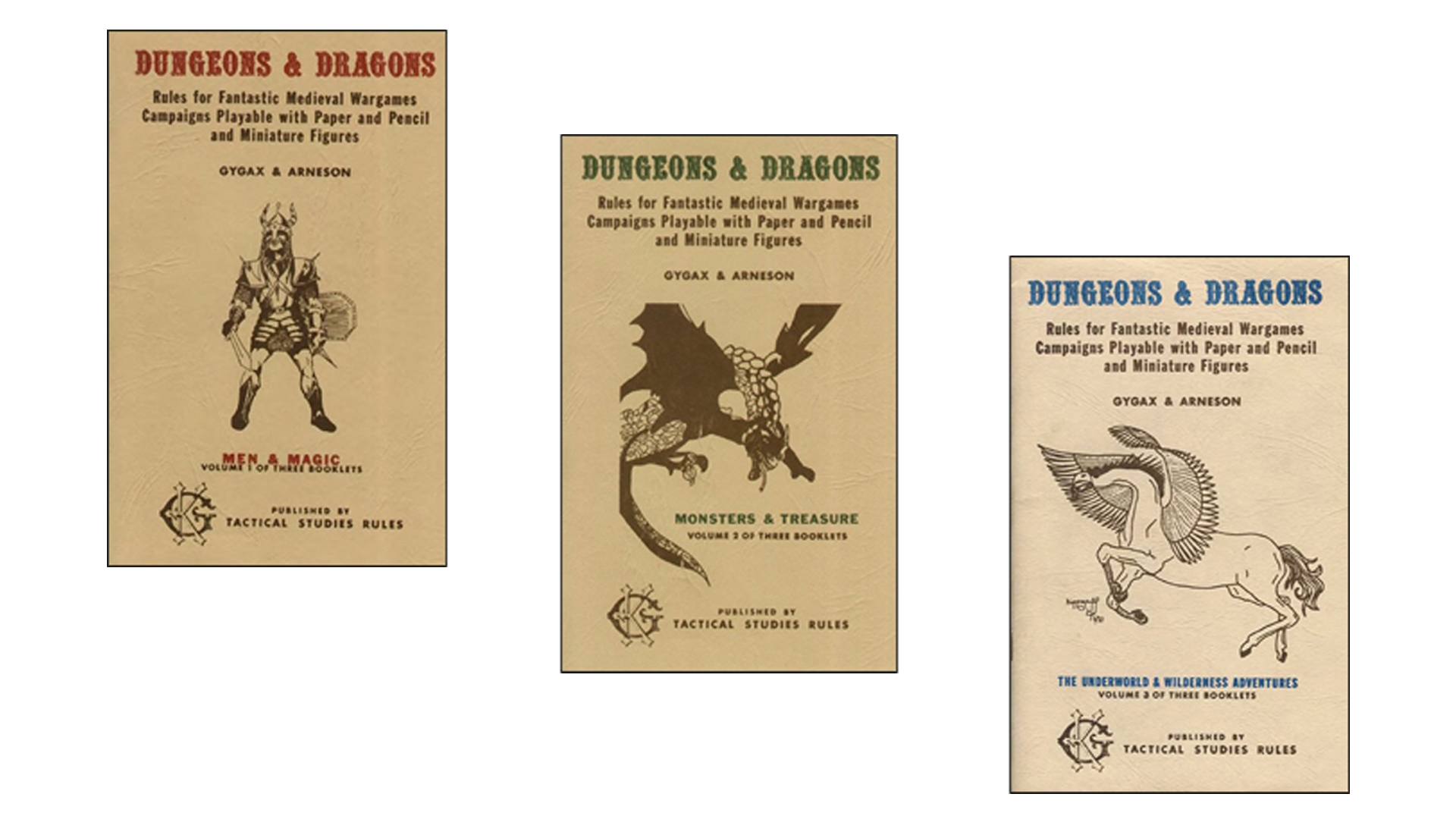
Saturday, July 24, 2021

Great Greyhawk Campaign: Playtest Modules

After the original adventures in Castle Greyhawk and the wilderness, when the World of Greyhawk had been published, play moved on to be mostly playtesting of modules for publication, from Village of Hommlet, to Temple of Elemental Evil, Forgotten Temple of Tharizdun, Against the Giants, to Into the Depths of the Earth, as described separately. The campaign never finished, with Gary being booted out of TSR and losing the rights to the world he had created. 

He also published the "tournament modules" Lost Caverns of Tsojcanth and Tomb of Horrors -- at least the latter was also adventured in by his group.

The old AD&D modules are best played with the system for which they were intended. Having some skill usage and abilities outside of the PC classes will broaden the scope for the DM and the players alike. [35]

I would put in an module's location wherever it suited the campaign at the time...mainly near where the PC party was. [35]

Of course the ones with which I am really familiar are those I wrote or co-designed. Of those, the ones I most enjoyed DMing were G1-3. D1-3, S3, and T1 and Temple of Elemental Evil...although I must say that running The Lost Caverns of Tsojcanth, Dungeonland, anf Isle of the Ape were fun for me if not uniformly enjoyed by the players :eek: All the others fall into a second place, including the ToH :lol: #6104

In modules I authored I created and named the characters for player use. This was done without reference to any existing PCs. Actually, I made the characters as if I would want to play them personally, then stuck them with rather questionable names for the sheer delight of being able to do that. I suspect it was a case of over-reaction to seeing so many really purile and stupid PCs names over the years...and I include my own PC fighter Yrag in that lot [35]

D&D Basic Set Exampel Dungeon (Tower of Zenopus)

J. Eric Holmes did design the sample dungeon in the first D&D Basic Set. [35]

The Tower' [of Zenopus] was Eric's...possibly with input from his son who was a young teenager back then. [35]

Find all the detail about Gary's edits to the original manuscript at Zenopus Archives

B2 Keep on the Borderlands

I believe this is the only one that was not adventured in by his original group. 

Many DMs contactd TSR stating that their adventure material was lacking, asking that we publish modules that they could use. If course we had to have a beginner's module for the D&D Basic Set... [35]

The B2 module was written to introduce newbies to the wonders of D&D adventuring. It is not "ecologically correct," but it is fun and entertaining, packed full of new and different challenges. Just between you and me, it makes as much sense as most things in the D&D game such as massive flying dragons that breathe various deadly things. Those who swallow the camel of the entire concept, then strain at gnats of particular monster or situation seem to be be losing much of the basis for playing. However, that sort of thing happens as one becomes familiar with the fanciful and begin to qualify the experience by comparison to reality. As you note, modules for more experienced players have more rationalization for setting and encounters.
The short answer is, if you enjoy DMing the KEEP ON THE BORDERLANDS, then why not use it? If the players question anything, make up something on the spot to answer the challenge #1671

[B modules other than B1, B2] To be blunt, most of those places never existed in my campaign world :wink: There was no need for them as I had no problem creating new adventure material for those that played in my campaign. [35]

DMG Example Dungeon 

The example you note was created especially for the DMG and was not a part of the GH campaign. Wherever possible I kept the two separate so as to have the large group playing in the campaign getting new material. #1996

I believe the story here is more complicated. There is some fantastic sleuth-work that shows suprising similarities between the DMG Dungeon and the Moathouse Dungeon. Likely the original Moathouse dungeon was the progenitor for both the published version and for this map.

Village of Hommlet, Temple of Elemental Evil, Stoink and the freeing of Zuggtmoy


I have DMed for so many people that after so much time has passed since running adventures in the Villiags' and environs, I'm quite unable to recall the many details of those events. I do not usually make noted of gaming sessions, save for correcting the working draft of the scenario of when doing campaign reports--that I have little time for or inclination to labor over. 
 [35]

The village and main temple areas were carefully mapped before I began adventure sessions in the area. The random generation was used mainly in developing the land around the village and some of the side areas surrounding the main rooms I had done for the temple dungeons.
As a side note, the random tables worked quite well, but they took too long. I found that it was easier and quicker for me to just bash ahead as usual and put in whatever I liked at the moment. #1793

I play-tested the VoH, ToEE, and the unpublished, lost Bandit City of Stoink with a large group of players including my Son Luke and Skip Williams. It was the base for a whole new campaign I started  [35]

Along with the Village of Hommlet module, Temple of Elemental Evil was what I planned as part of an ongoing demi-campaign series, something regarding Stoink to be the third, and then wherever my own group's play led for a concluding offering. #5672

My group spent a lot of time with adventures in Nulb and Stoink. That's another reason why I didn'd add more dungeon levels to the Temple...no need, as dungeon crawling was not paramount #6506

The Moathouse was subsumed as being built by a local lord some decades before the ToEE came into existance. #8683

After a lot of adventuring fun in Hommlet, and a foray into Nulb, the team went into the ToEE, explored, fought, withdrew, and came back again repeatedly. Robilar went in alone, smashed some magically shut gates with a pillar, and freed Zuggtmoy. Scenario over. #2749

When the WoG was completed, I decided to start a new campaign based on Oerth rather than continue using my generally undetailed parallel earth setting. Thus I created the VoH, ToEE, Nulb and Stoink for nearby town adventures. As I had the whole envisioned from the start, there was a good deal of continuity in the end products. the Temple was meant to be the dungeon crawl base replacing Castle Greyhawk, and more levels would have been added, but... 
When Robilar freed Zuggtmoy, I pretty well scrapped the idea of using it for ongoing adventures for my group, vowing to get back to finishing it eventually. As I was not able to do much DMing thereafter, that never happened, so Frank browbeat me into having him complete the unfinished ms. for the ToEE. Of course, that did not have the added levels, but it was complete and in order.
Frank followed my initial material, understands that I write with mainly critical details only so as to encourage the DM to make the work his own. #4698

To cut to the chase, his possession of the orb is not general knowledge to the leaders of the Temple--only the general location of the object inside the place. Falrinth is as you describe him, self-interested and not particularly devoted to the aims of those who are in charge of the place. [35]

Lolth never made any appearances, but Zuggtmoy did. When Robilar freed her (yes, he again loosed another deital figure) she was grateful, took him off to her layer of the Abyss to be one of her favored servants... Robilar, and he was a veteran adventurer at this time, was not a happy camper then. #374

The Demoness Queen of Fungi was not so clever, Robilar was brash. He tossed a pillar through the door sealing Zuggtmoy into the chamber in the ToEE. She got a look at the handsome adventurer, noted his evil aura, and as a reward for freeing her carried him off to the Abyss as her body servant. I did no go into details there, but eventually Robilar convinced her of the imcompatability of a lawful evil servant in her realm, so she sent his back to the PMP.  #5451

Rob was rather upset when his main PC was likewise treated, Robilar's orc henchman Quij, made a poncho out of the Flying Carpet he was guarding due to the long wait and cold nights, and eventual seige of his castle as word got out that Robilar had freed the evil from the Temple of EE... #5453

As for the Temple of Elemental Evil, Zuggtmoy is unkillable. she can be set free or sent back to the Abyss, but the PCs can not destroy her. #5599

No need for me to look at any other's take on the Demoness Queen of Fungi, the Zyggtmoy I created is the ONLY true exposition IMO. That is the depiction presented in the ToEE, of course #4838

WG4 Forgotten Temple of Tharizdun

Actually the muse strick, so I devised the darkest evil entity I could envision, then devised the supposed tomb scenario to see how players would have their PCs react to it. Only a few felt the strangeness of the place, the sadness evoked by the loss of horrific evil. I did indeed control the art direction of that module. #5457

The Forgotten Temple of Tharizdun was done with as much melodrama and pathos as I could muster for a rotter such as I envisaged that one to be. A few DMs really appreciate the mood of the module, its underlying implications. I specifically selected the unusual art to enhance the "different" aspect of the work. I say all that for your benefit when perusing the material. #4411

Of course The Forgotten Temple of Tharizdun reflects my DMing:D #1250

The vile evil of Tharizdun is such that the adventurers must be comprimised to some extent in order to gain any real material reward from his temple. the truly benign party that refuses to yield thus to gain riches should be rewarded by special XPs. Likely I should have stated that, but when I wrote the module I was still making assumptions regarding the perspicacity of the vast majority of DMs that would use the adventure material...as if they could read my mind :\ #4432

S4 Lost Caverns of Tsojcanth

Just a typo there. My original spelling was Tsojcanth, a name I made up to sound exotic even in the WoG context. #8702

I invited Rob to co-write the Lost Caverns of Tsojcanth with me, after a couple of my PCs had adventured in his similarly mapped area. He declined, so I created a different map from that which he had made, and devised original encounters as well. #6138

G1-3 Aainst the Giants

As a case in point, when I did the "Giants" series, I began with only the hill giants fort, but as that developed, the concept of a larger adventure came, so that by the time I had finished G1, the springboards for G2 and G3 were well in mind, and the whole of the underworld to follow as well. #1698

What has astonished me is than no group I know of has ever attemptet of impersonate young giants in the G1 adventure. I set it up so that could be done and would likely be effective too... #4965

By the time I wrote the G and D series modules, the group of players I DMed for had altered considerably from that of the early 70s, although Ernie and Rob and Terry Kuntz were still there. The adventures in the two series were indeed a part of the overall campaign, and a number of the PCs involved belonged to TSR employees, including Tim Kask and James Ward. We played in the TSR building a good deal after regular working hours.
The successful handling of the G and D series didn't really have any impact on the campaign, save to beef up the PCs. When the lads managed to penetrate all the way to the Vault of the Drow it was most disheartening to me. They took one look around and made haste to get away, so they never did much in the way of wreaking havoc down there, let alone run into Lolth or the Elder Elemental God. #2308

G3

[King Snurre near the Entrance] Thinking back I most likely did it so as to offer a really major challenge to the adventuring party early on. While I didn't mention it, when I DMed the scenario I had King Snurre move to another area and set up an ambush with his flunkies when the PCs returned loaded for bear to get him. I recall Jim Ward's PC used a magic jar spell to take over the queen, and the party were nost eager to get poor little Obmi #5360

The dragon was there as a part of the muscle of the fire giants--for attack and defense. It was not a part of a singular plot, but there as a general member of the overall one. #5660

Someone suggesting hit-and-run teleport tactics or deporting to the etheral or astral plane to rest:

If you apply the danger of use of the teleport spell, it is likely that there will be some dangerous times for the PCs. also, after a second raid such as you describe the giants would surely get help not otherwise mentioned in the module, say some objects that dispel magic. [35]
Those on the Ethereal Plane are able to see the PMP vaguely, as if thtough a thick haze or several layers of gauze. Assume vision extends out to a maximum of 30 feet, although movement of large objects could be noted at 60 feet distance. That you suggest for using the Ethereal Plane as a resting place is chancy, for many potent monsters can become ethereal and do so, traveling the place. If PCs playing in my campaign tried the tactics you suggest, they'd end up getting little rest and fighting a lot of opponents more dangerous than giants. When a few dismembered carcasses of PCs come flopping out of the Ethereal Plane I suspect the concensus will be that it is not a viable means to cheap success in quests of heroic sort. [35]

Indeed the Astral Plane is similar to the Ethereal, albeit there are even worse perils to risk when hazarding that plane other than for direct travel to a destination. (In short, it is up to the DM to make certain that the players do not get away by cheap tricks, the louts!) [35]

S1 Tomb of Horrors

A chap named Alan Lucien gave me the inspiration...as I believe I stated in my original ms. for the module.  [35]

[Tournament Modules] There was little change from the campaign version of the modules in the published versions--added pregen characters is about all as I recall. #5776

The Tomb of Horrors was inspired by material sent to me by Alan Lucien, and I believe I have credited him in this regard, but it has been so many years I can not recall where and how. Anyway...
The place was designed to test the mettle of the best players, stretch their ability to the maximum. That it did, while nor a few PCs belonging to very capable players bit the proverbial dust. Those players with real cran came back and kept trying until their PCs suceeded or else the DM grew weary of running the module. As I have mentioned, in my group only Rob Kuntz managed to get to the end of the advbenture, Robilar losing all of his orc flunkies at the onset, in the initial passage. When he found the tomb of the demi-lich Robilar scooped all the magical treasures he could into his bag of holding and ran off leaving the demi-lich hanginf, as it were. Tenser retreated from the perilous place, as did Terik.
Of course Mordenkainen never entered the place, but had he, the wily wizard would surely have come with his most potent associates, and brought plenty of powerful magic along. As with most other dedicated players, I too am averse to losing my favirite and long-luved PC. #5480

The material in the ToH was for narrative purposes, color. I didn't wish to make the demi-lich an ongoing antagonist, for I thought it far too limited, so no details beyond those given in the module were developed. that sort of treatment also allows for free creative rein if one wishes to further exploit the subject [35]

Only the most veteran of my group attempted to explore the ToH with their regular PCs. Son Ernie and Terry Kuntz retreated when they discovered how difficult and deadly a dungeon their PC faced. Rob Kuntz with PC Robilar made it to the end, losing some dozen or so orc troops along the initial route, and when faced with the rising skull of the demi-lich did the logical thing for his character--scoooped up the treasure and retreated in utmost haste. Note all of those forays were by single PCs, Robilar accompanied by flunkies.
A number of large parties of PCs made the journey into the tomb, some with many survivors, and two I know of defeated the demi-lich. The most innovative solution was by a tournament group that used the reverse end of the scepter to touch the crown gained with it in the throne room. When the skull arose one of the PCs popped the crown on it, another used the scepter, and the demi-lich was powder. Russ Stambaugh was their DM, and when he told me what they had managed to pull off, I awarded them first place hands down.
The adventure is meant to be deadly, kill off all the unwary PCs, and make the survivors paranoid. It is best played with characters created for the adventure, not the regulars in a campaign, as the ToH is unforgiving and often results in TPK. #2003

I didn't actually do much in the way of background, leaving that open so that when I brought Acererak into some yarn before he became a lich, after a demi-lich, I would have more creative freedom. #5110

I initially said Ace-RE-rak, then changed it to A-CER-er-AK because it sounded more exotic and threatening to me  [35]

As far as I am concerned, there is absolutely no connection between Acererak and Vecna! #8770

I never allow summoning of monsters in the ToH, so the party that enters can not be reinforced along the way. #6948

Robilar did venture into the ToH with a dozen of his orc bodyguards, but the lot were wasted in the entrance passage--I placed the pit traps knowing Rob's thinking and so got an orc in each and every one. Robilar tossed the last of them into the demon-mouth sphere of anhilation, then ventured on alone throughout the remainder of the module, got to the end, and as I said before, looted the treasure and fled without confronting the demi-lich. #4462

Robilar did that deed, but he then beat feet, no teleporting spell involved. IIRR, he had replaced his lost Boots of Flying with Boots of Speed :uhoh: I was quite unprepared for such a dirty trick #7749

As son Ernie has said, when Tenser saw the nature of the tomb he simply retired from it not caring to risk life and limb for whatever treasure it might hold. Anyway, as far as I am comncerned, Acererak needed some great source of magical negative energy to return to regular lich state, be able to manage such a return to his former "glory." #7747

Ernie playing Tenser didn't go for the situation and cleared out. Rob playing Robilar made it to the end, grabbed all the loot, and didn't bother fighting the demi-lich--not much profit in that by his estimation, not with all the treasure in his bag of holding.  #4422

A good example is the Origins I dungeon -- incidentally drawn from a similar tomb designed by Alac Lucion. Very few of the players who engaged in the tournament were able to think out the problems. In a test run, Rob Kuntz, in his game persona as a 13th level (evil) lord went through the entire tomb in four hours actual time. He took 14 orcs and a couple of low-level flunkies with him. He lost all the party, but his character personally looted the lich's tomb and escaped with the goodies. [46]

The original typewriter pages of the tournament module for ToH still exist and can be compared to the published module, for confirming Gary's recollection.

D1-3 The Underdark

My concept was that Eclavdra was aiming at dominance of the Drow through using the EEG to replace Lolth. she, as the chief priestess of the elemental deity would then be the mistress of all. The final scenario was to have been one in which the adventurers got involved in the battle between the evil entities and made it so that both lost and were tossed back to their own planes, relatively powerless in the Mundane world for some time to come.  #862

All the material in the D series was done exclusively by me, illustrations aside, of course. The additional areas of the underworld were sketchily detailed, but I have no idea where those notes have ended up:(
My players were not much delighted with the thought of continuing adventures there, so my efforts came to no useful end. My next plan was to detail the city or Erelheicindlu, but the lads absolutely refused to take their characters into the place #1349

They felt the risks weren't worth the possible rewards. It was much the same in regards to adventuring on the Isle of the Ape where they calculated that the likelihood of PC death was too great for any possible gain thet might come from successfully managing the whole adventure. In sum I believe that they also didn't want to have to do all the roleplaying necessary to deal with the potent evil creatures they'd encounter regularly in the Drow city. #1364

The Sunless Sea was indeed meant to serve as a place for further subterranean adventuring, of course. Always leave some room for that sort of thing, obvious or concealed in the setting #862

To discover the temple the party was meant to do some big-time roleplay by entering the city of Erelheicindlu and mixing in with all the Evil NPCS and monsters there, ask questions, mabe even take a prisoner and question that one. Of course, many of the inhabitants of the Vault would know where the fane was located, so the DM could decide how to manage the matter--bribery, threat, whatever. #832

Oddly enough my group was not enamoured with the Underdark, especially the actual Vault of the Drow. I had hoped to make things rough with the vampire and succubus couple but they immediately became suspicious and alert when they saw the beautiful moonlit garden. #7128

I had hoped to get to the Elder Elemental god in a sequel to the ToEE, but... #860

I wrote the D Series after the G ones, and both were set in the Flanaess, for by that time I had finished the world setting. It was easier for me to use it, what with the complete map and all #4351

As for other large-scale maps, I was tinkering with some, developing ideas for more adventures in the depths, but none of my players, and that includes the most able with very potent PCs much cared to explore there, so I scrapped the plan. #263

Well, Iggwilv could be anywhere it seemed a good place for her to have living or other sort of quarters :eek: If the party were sufficiently strong, they could indeed have an encounter with that lovely lady... #4690

D3 Vault of the Drow

The G series of modules were aimed at testing PCs of mid level, and the D series were for higher level characters. The Drow city of Erelhicindlu was meant to be a scary place for 16th - 18th level PCs.
Outside of the Vault of the Drow, I have run very few high-level adventures. All of my players retired their PCs from general play when those characters reached the mid-teens in level. As most groups are of lower level, having a potent character with a party of lesser sort was not much fun.
I never used the tarrasque (Francois did in his games, also demi-deities). When wishing to challenge high-level PCs I use a combination of potent monsters, including demons or devils and tricks and traps. The encounter with the vampire and succubus in module D3 is a good example of that. #1975

You are the first one outside my family and confidants to note the relationship between Belgos the vampire and Bela Lugosi. [35]

If I could revisit something, two adventures spring to mind immediately--the city of Erelheicindlu in THE VAULT OF THE DROW and the Elder Elemental God and what might lie below the ToEE. #49

Although I did my best to get them to adventure in the city, none of them were willing to take the risks required. So they avoided the place as assiduously as they did the Isle of the Ape and my favorite critter, Oonga. [35]

We did have PC in the place during a tournament we played at one of the small cons TSR ran in the winter, spring, and autumn; and one group did roam around a bit in Erelheicinlu without mishap. Another party were spotted by Drow, promised fair treatment if they surrendered, and they did just that. Of course the lot of them were stripped and sacrificed to Lolth. [35]

Isle of the Ape

Terik was also the main actor in the various IotA [Isle of the Ape] adventures, as he took great exception to the chief's and witch doctor's initial treatment of him. A series of attacks followed, with retreats coming in due course, and then return visits with comrades to take revenge. Only after finally roughly handling the native population did the crew go into the island's interior. One PC, and I won't say which, met Oonga, got grabbed, wrenched, bittem, thrown down, and then drop-kicked off the ledge of the cave. A wish was expended to save him. That ended all interest in further adventuring there #436

As for the Isle of the Ape, most of my guys hared it, but I loved that module, as I love the original King King motion picture #5854

Orcus and Asmodeus

When playing in what became the D3 module someone in the group managed to gate in Asmodeus, and another character called for some entity as strong as that to oppose that devil. Of course I brought in Orcus when the call for assistance was deemed successful. The two are actually opposed of course... They had a fine time laughing at the grovelling mortals, then failed to agree as to who got whose souls. The dispute escallated, and the party escaped.
Not a lot of demons and devils were encountered in my campaign, and when they were it was usually a major fight to get rid of them. They tended to keep gating in reinforcements.
I would sometimes create a unique sort of minor demon or devil for the party to deal with, but. with the plethora of other monsters available this was a rare and "special" thing. #1107

As my campaign never got to the point where the PCs were of a level to dare any encounter with deities of even lesser sort than Orcus, the sum total of my development of the demon lords is pretty much contained in the core monster books.
The only anecdote I have regarding Orcus is this: When a party I was GMing was in the D3 module, they got into such trouble that they pleaded for divine intervention withoug being specific. As this was successful (a d% roll of 00), I had Orcus appear, he being the most potent deity likely to have attention focused in that area. At that point the party was toast, so knowing that they again pleaded for divine intervention, this time specifying a deity opposed to a demon lord, but no more. Again they managed a successful roll, so Asmodeus appeared. Having an immediate understanding of what was happening, the two Evil deities did not fight, not did they bother with the foolish mortals who had summoned them. That was beneath them, of course. So they gated out and left the party to their fate. A couple of the characters actually managed to survive. #1361

A group of players, including regulars that should have known better, did something that brought either Demogorgon or Orcus, I can not recall which it was, to the location of their relatively high-level PCs. They used a wish to call a potent deity opposed to that demon prince, not specifying that the one desired be of Good alignment, so who should appear but Asmodeus.
They were glad to escape with their lives, for I rules that the two great lords of Evil were so amused by such stupidity that they found it beneath their dignity to expunge such bumblers, that they would soon manage that themselves without the helping hand they could employ. #8675

In one tournament session at a Autumn Revel, as I recall, a team managed to bring Asmodeus to their location. In desperation, one of their number called for a diety opposed to that devil to come to them. Being a kindly DM, I had Orcus arrive instanter. Oddly, the party were not in the least happy that I allowed such "divine intervention." I suppose it is because the two Evil beings took stock of the situation, saw no reason to fight amongst themselves, and simply divided up the "spoils" between them and left... #374

Q1 Demonweb Pits

I had what I consider a much more interesting plan for the conclusion of the G-D series, one in which the PC party could loose the Elder Elemental god or send him into deeper isolation, thus assisting Lolth to become more powerful. By very astute play, they could have thwarted the designs of both evil entities. The Demonweb Pits were indeed envisioned as maze like, but there were to be no machines therein. #6349

There was a link between the Drow modules and the ToEE, mainly in my head, and after Q1 came out I rather lost interest in developing the former, as the EEG was not released from his banishment to a distant star (ala Set). I would have devised some other scenario to accomplish that, only the Drow and Lolth were not to be emulated in a hurry, and I ran oput of time to make the attempt, so Frank badgered me into having him complete the ToEE. #5615

Lolth is meant to be a horrific demoness, something worse that the creepiest of arachnids, and her domain was meant to be one of shadows and webs and all manner of nasty lurkers waiting to pounce. The maze was fine, but all the rest, expecially the mechanical stuff, was not at all what I planned. #6391

I did not write Q1, nor did I approve of it. complain to the Blumes, for they insisted on publishing it against my objections.
As for the chief antagonist, it was meant to be Exlavdra on behalf of the EEG, with the minions of Lolth, not the demoness per se., being second and a counterweight to the former as noted. The latter will fight against the Eilservs and tolerate for a time the presence of a PC party that is discommoding their foes.
When their efforts to free the Elder Elemental god from exile were thwarted, Eclavdra did indeed switch her allegience to a demon so as to remain powerful. The term Chaotic Evil suits all of the Drow well.
As for Q1, Ask Dave Sutherland and Brian Blume about that. It was taken out of my hands by the latter when Sutherland discovered the "Demonweb" pattern in a hand towel and talked Brian into using it as the main theme for the concluding module. I had no creative control over it.
I have said repeatedly in print that the Q1 module was Dave Sutherland's interpretation of Lolth, and most certainly not mine. In truth I thoroguhly disapproved of the work but Brian Blume had it produced. Steam power indeed :mad: #5599

When Dave Sutherland did the Q1 as it was, and Brian okayed it, I was rather stuck. Lolth was supposed to be in there, and in the depths the prison of the Elder Elemental God. I had my hands full with the management of the D&D Entertainment Corp. out on the West Coast, so I couldn't get to the completion of the ToEE. That's when Frank Mentzer took a hand and filled in the lower levels that I hadn't detailed. That's why they ended where they did instead of proceeding downwards more to where the EEG's area was going to be. #1421

Dave brought into the TSR offices, then at 723 Williams St., a towel that had a marvelous design that was perfect as a demonweb, so that's how he got into the project for creating the Q1 module. My outline for the whole was for a demi-plane outside of the Abyss, a great spiderweb with encounters at junctions along the way to the center, Lolth's abode there in the middle. The PCs would need to gather pieces of an artifact based on the four elements in the web in order to be able to face the demoness and send her packing back to the abyss. Of course, that would have called back the Elder Elemental God from his place of banishment... #5602

[Four shapes in the egg in Q1] When I wrote an adventure I always tried to put in a few disguised hooks for later exploitation, or not, as the creative muse moved me.
As you note, the shapes were repeated in the ToEE as I did intend to tie the latter into the series. Lolth was to be connected to the temple, she the key to activation of that which would remove the imprisoning bonds from the Elder Elemental God. Of course that would have been by unintended consequences of her actions when the PCs discovered her.
How it was all to operate was something I never did get fleshed out. This was to happen in the lower levels of the temple, the development of which I never got around to because of my work out on the West Coast. #1423

I was reserving Lolth, the drow, and even the Elder Elemental God for detailed treatment in a separate yarn that never got written. Seems the popularity of the dark elves rather closed that avenue--Bob Salvatore's books and all. #1288

I was intimating that Lolth had taken a shine to Lareth, as he was beautiful, regrrdless of where his loyalties, if you will pardon the misapplication of the concept, lay. Lolth too can covet another's property... #6478

Expedition to the Barrier Peaks

I authored the Expedition to the barrier peaks, and it was a downed space vessel as noted, nothing based on any other work. #4498

The End

As a matter of fact I ceased the campaign in 1985 when I severed all times with TSR. #6948

[All Gygyx Campaign]
Keep on the Borderland
Village of Hommlet
Temple of Elemental Evil
Dungeonland
Land beyond the Magic Mirror
Lost Caverns of Tsojcanth
Forgotten Temple of Tharizdun
Steading of the Hill Giant Chief
Glacial rift of the Frost Giant Jarl
Hall of the Fire Giant King
Mordenkainen's Fantastic Adventure
Tomb of Horrors
Descent to the Depths of the Earth
Shrine of the Kuo-toa
Vault of the Drow
Isle of the Ape
(Necropolis, final portion)[35]

Necropolis

The Necropolis super-module was inspired by my own initial dungeon encounter area with an Egyptian theme. As I was studying/researching the Ancient Egyptian religion and the Duat underworld, the whole was pretty easy to create at the time. [35]

Castle Greyhawk at Conventions around 2005

How right you are, though, about the newer players not knowing when to retreat so as to fight another day! that's how my Old Guard Kobolds came into being, grew to be a force--killing PC parties that stayed and fought when it was clear they couldn't beat the little buggers. #3426

I have DMed OD&D, the three-booklet really original version, at a dozen cons over the past few years. I have players roll 3d6, record the scores in order. and play the characters as developed thus. I do modify the rules in regards HPs, have any 1 rolled count as a 2. We have a great time. Of course that's mainly due to nostalgia on the players' part, and I do my best to make the dungeon crawl exciting and unusual--encounters such as those with my Old Guard kobolds. #1751

As a DM I made lemonade out of the "lemons" of the new players' reluctance to flee, to stand and die before a foe that was trashing them. That is how the Old Guard Kobolds came into being, and they have grown in both individual ability, numbers, and organizarion so they now pose a meaningful threat to PC parties of 4th or 5th level. Sadly, a group of such PC that were veterans took most of them out, but it was a casual play session, so I won't count it against the little humanoids #5651

Of course I not only think that they are, but have observed the coddled state of many new gamers as they died before my now beloved Old Guard Kobolds or met otherwise useless deaths because they: 1) were not thinking, and/or 2) assumed that whatever they met in an encounter they could deal with, and/or 3) they expected a special DM intervention such as a save when they totally screwed up.
Finally, there is no distinction between "having a PC figure something out" and the player doing so, Unless a psychotic schizophrenic is playing, the two are not separate entities, as the player is making believe he is the game character. #5645

I just played a house ruled OD&D (three booklet) adventure at the Winterdark convention here, taking six created-on-the-spot 2nd level PCs on a dungeon crawl through the upper levels of my original Castle Greyhawk campaign, those dungeon levels being created in 1972 and 1973. #8670

In brief: We are using the three booklets. HP rolls are re-done if a 1 comes up. Fighters add +1 per die, and all PCs add +1 if their Con is above 14. Fighters add +1 damage for Str above 14. Dex does not affect AC just missile attacks. That's about it. #2217

As for the mule, a wandering monster was indicated--the mule and the cart are noisy and attract a good deal of likely unwanted attention. As it was left alone, the mule was the prime target for the hungry gelatinous cube. #8077

The Small Greyhawk Campaign 2007

Gary reran in the upper levels of an abbrevieated version of Castle Greyhawk in a home campaign. This is of course a great source of information on the dungeon. Also, his rules amendmends may give some insight on how he thinks things should be handled, although they may differ from the way he used to run it in 1973.

I have only the 40 or so levels of the original Castle Greyhawk for A/D&D play. I am using seven of them in a separate format for this particular mini-campaign. In play-testing the Well of Shadows LA game adventure, my veteran players found the number of levels, seven therein, about as demanding and intense as enjoyable. Seven dungeon levels for a crawl is about twice that number in a formal module, so I know I have plenty of material to keep the group delving. #2938 

Yes, only the three booklets and with house rules adjusting HPs and the effects of high, 15 or better, attributes of Str, Int, Wis, Dex, and Con. Each is given a +1 benefit to stats or spells. #5558

GYGAX HOUSE RULES 2007
• STR > 14: +1 to hit and +1 to damage if a Fighter
• INT > 14: +1 1st level m-u spell
• WIS > 14: +1 1st level cleric spell
• DEX > 14: +1 to AC, and +1 to move silently
• CON > 14: +1 HP per HD (same as a Fighter class gets, +2 if a
Fighter)
• CHA > 14: +1 (positive) on reaction checks
• HPs: Characters are only unconscious at 0 HPs. For each level a
character may have a minus HP total equal to the level, so a 1st level
PC is dead at -2, a 2nd level at -3, etc.
• When taking damage allow -1 HP per character level

[From a Gygax post via Cyclopatreon, after the original forum post went down. I believe the last bullet is not some kind of damage resistance, which would entirely negate most attacks once you'd get to level 8 or so, but means the same as the second to last bullet, you can survive to -1 HP per level, so at level 3 you could take damage to -3 HP and still live. It's not clear to me why this last bullet would be needed, but the other interpretation sounds just too insane.]

My campaign group here is playing in a turncated version of the original dungeons that has indeed been "upgunned" because PCs have enabled the monsters inhabiting the levels to become better armed and most astute in their tactics. That said, I made the group begin 3rd level characters in hopes that they would feel more confident in exploring lower levels. THAT THEY HAVE REFUSED TO DO, AND NOW THEY HAVE ABOUT THREE QUARTERS OF THE 1ST LEVEL MAPPED, AND ONLY A 3RD LEVEL M-U AND HIS GUARDS, A BAND OF GOBLIN SLAVERS, PLUS THE TWO COMPLEXES IN WHICH THE OLD GUARD KOBOLDS HOLD REMAIN AS ACTIVE ENCOUNTERS.
You are correct about the power of the PCs. I am using original D&D rules with only some few additions, so HPs and spells are limited drastically at 1st level. (At the time when those rules were written, it was assumed a typical adventuring party would have about 8 PCs plus as many hired men-at-arms #2168

We are playing the three-booklet version of D&D now, and I don't use any supplements, just rules changes I have made to give greater viability to the beginning characters.
When we play AD&D I use all the core rules, including the material in the UA book, or not. If the group is really old school, then we do not use the UA changes. I can enjoy DMing either way, so the players decide what they prefer. #2735

Gold: $500/ounce (coin metal)
Silver: $10/ounce (coin metal)
Copper: $1/ounce (coin metal)
Platinum, pure: $750/ounce #2218

Actually, I have been using the old dungeon levels in both OD&D and OAD&D play at many conventions over the past years--even ran my group through several of the oldest upper levels just this spring. thus I am well in tough with the material and the "feel" needed to re-do the whole in depth. #4414

The Swine! :]
I refer to my players and their filthy 5th level PCs of course. Picking on those fine upstanding little kobolds at their level. They should be ashamed, not bragging and thumping their chests. It took a hold person the three sleep spells to do the vile deed.
Fortunately, they are adventuring in an abbreviated dungeon level construction, so the actual Old Guard Kobolds remain unaffected, are still around to beat the crap out of lower level parties not sufficiently astute to run away and come back when they are at 5th level :uhoh:
The party had pretty well mapped the first level, and the only remaining force there were the OGKs, so I suppose it was inevitable that the poor little dears met their fate. It gave me some considerable satisfaction that they dropped the offending magic-user to 0 HPs twice during the enconter. It was as if the random dice determination for PCs hit was sentient, knew that he was the instrument of their doom. He dropped 12 of them with his third sleep spell...
The thouls awaiting the party on a lower level will wreak revenge for their depridations above. As they are active in the dungeon complex, only wandering monsters will be likely to be encountered on the depopulated 1st level. #2704

As a matter of habit I seldom use miniature figurines. None of my regulars bring one to represent their character/Avatar, and while I have plenty of such figurines they could use, I do not have much in the way of creature sorts, so those would have to be dice. That sort of spoils the spectacle. When we do formal demos, though, we use Dwarven Forge dungeons/caves and miniatures. #5587

In the O/AD&D games I DM, I hand out XPs for eliminating foes, using spells and skills, doing the thing called for, mission success, as well as for loot gained--the latter being the main reason for most adventuring #6435

As the players don't seem particularly interested in town adventures, I skip all that and simply take away large amounts of money when they are in the city regaining health, resupplying, etc. That obviates the need for them to do what they would consider a waste of valuable adventuring time in hunting up a mage to id items for them. [11]

At 0 the PC is uncoscious (with a further -1 per level, so a 4th level fighter can be at -5), but a potion or a cure wounds can restore them immediately [11]

I do require that they taste potions and experiment to find out what the liquid does. If they discover something unusual, likely I'll have them visit the Striped Mage to have the object explained... [11]

[References: see Greyhawk References]

Friday, July 23, 2021

Actual Rules used in the Greyhawk Castle Campaign

The published rules reflect the practice of play from the original campaign, but not everything needed to play is included in the OD&D leaflets (for example rules on initative are missing, or rules on number of monsters encountered in a dungeon encounter). And after publication they evolved, as shown in the Greyhawk and other supplements, and later AD&D. 

Likewise, not all the rules that were included in AD&D were actually used by Gary's group (and for good reason), he left out psionics, weapon speeds, weapon vs armor and the overly complexe initiative rules shown there. In the Castle Greyhawk  campaign, a lot of rulings were done on the spot, ignoring the books, to keep things moving, and therefore also the rules for class abilities or spell descriptions were often left vague, to allow the GM their own interpretation. But of course, players arguing one way or another wanted clarity. 

I think Gary is right, if you spell out all the rules in detail, and then try to follow, this often leads to unwieldy long rules, in which you cannot find anything, and then spend your time looking up and reading up rules, instead of having fun, "Rule-Playing". 5e does a very good job to cover lots of bases with a relatively small set of rules, and also clarifies often that something is left to interpretation, and even there you have a sage advice blog with hundreds of nitpicky questions.   

Here are the rules that were actually used, this a mix of rules from OD&D and AD&D time frames. 


Stat Rolls & Bonuses

As stats became more vital to a long-lived PC, I improved the players' chance to get a viable one quickly, one that they would be happy with. In my campaign I allowed rolls of 4d6, three highest for the score, and arrangement of scores as the player wished. That enabled the creation of a character the player wished to play, of course. #1145

As a DM who wants the players to be as pleased as possible with the process. I typically allow stat rolls of 4d6, taking the three highest, and allowing the totals to be arranged in whatever order the player desires.
In regards to HPs, I typically say re-roll any 1 #4089

The usual is to have all the players roll up 2nd level characters--fighters, clerics, magic-users, dwarves, elves, of hobbits. I have house rules so that any score above 14 gains a bonus of some sort for the PC, As all the team os 2nd level equiment is whatever on the list is desired. 
15 + attribute score chart:
STR +1 to hit for all (& +1 damage for fighters)
INT +1 1st evel spell (for m-us)
WIS +1 1st evel spell (for clerics)
DEX +1 to AC (for all)
CON +1 to each HD (for all)
CHA +1 to reaction checks (for all)
The party then enters the original 1st level of my dungeons and goes on from there.
This ensures that there is compatability of PCs, and believe me there is plenty of exploration and action to be had. [11]

We did indeed use the reaction adjustment for charisma as stated. That was used considerably when a PC was meeting and seeking negotiation with an NPC. No added rules were needed, only the DM's determination of what the PC's charisma would come into play. Persuation is pretty well a self-evident factor in interpersonal dealings. #5188

The minumum is just that. If any penalty reduces the character below the required minimum, another race must be selected...or a new set of character stats generated...  [11]

HP

In 1972 we all rolled 3d6, but later when AD&D made the stats more meaningful, players would keep rolling until they got more viable numbers, so then we switched to various systems--roll seven or eight times with 3d6 and keep the six best totals or roll d4d and throw out the lowest die.
After all, the object of the game is to have fun, and weak PCs aren't much fun for most players. Even fine role-players want characters with at least one or two redeming stats...

I usually used method I, 4d6, toss out one, arrange the totals in any order desired, for that allows the player to have a better shot at getting the sort of character desired. [35]

[hp level 1] Yes random rolls were made, but I always allowed a re-roll for a result of 1.

I never used re-rolls in my campaign, nor did I ever play with a DM that used that device. What is rolled upon gaining a level is what remains ever thus, unless there is magical alteration or divine intervention. #8597

[Multiclassing] Add HD and average at all times. If a level is lost half of the average of one HD is lost in the process. The character's level is the higest of one class and half of the levels of another. thus a F6/M-U4/T6 is equal to 11th level No it is the total of the highest plus half of the other. [11]

Monster HP

For big monsters like demons I was using d10. I used the 9 HD column for 8+8, but one could reasonable use the 10 HD column. #1664

Indeed all the PCs got an extra HD per level after an initial few months of play otherwise, even the MUs. then we always had fighters gaining +1 point to the die roll, and we counted Con bonuses only for fighters. This general idea was reflected in the varied HD gain used in OAD&D, with fighters getting d10, clerics d8, magic-users their d4, etc. #2482

I play it thus: Of the critters are raiders, warriors, of active hunters I assume that all of them will have one-half or more of the possible HPs for their type. If I want to make the encounter special, I then see if any of the members are in ill health or wouded.
For straight out confrontations, though, I just have at it with HPs as noted...and ogres and giants and like big and tough monsters have d12 HD. #7523

I have indeed tinkered with hit dice. Currently I use further adjustments for mature and robust members of a species. If the HD involved is a d4, the spread for each is 3-4, for d6 it is 4-6, for d8 it is 5-8, etc. That avoids having pushover adversaries that are supposedly potent ones. Young and old members of the species are treated in the obverse in regards to HD point spread. [11]

I say that as barbarians get d12 for HPs, then clearly extrapolation of the same principle must apply to large and vigorous creatures. This mitigates the potential increase in PC prowess. As a matter of fact, adult critters were assigned 7-12 HPs per HD in my AD&D campaigm--have been given the same in what I have designed for the C&C game system. Also, with increase in damage due to Strength, all large and powerful monsters, including ogres and giants, gain a damage bonus equal to their number of HD.
Admittedly, this is not in the UA work, but it logically follows, and would have been included in the revised edition of AD&D that I was planning. #7786

Skills and Proficiencies

Gary also used a simple and practical way to approximate skill checks, similar to what Das Schwarze Auge did in Germany in its first edition, estimating who would be trained in what kind of skill based on the class background. 

If a player wanted a character to do something not covered by class but otherwise logically possible I would usually have a check rolled against the associated ability, with a bonus or penalty depending on the action and the difficulty rating I considered applicable. the rolls were made on d20 against the ability, as adjusted, a score of at or under the number arrived at meaning a success. #2015

As AD&D is a class-based game, there is little recourse to skills. A ranger, for example is assumed to know a lot about survival in the wilderness, that including what plants are poisonous or beneficial. I use something like 5% chance per level, plus Intelligence for chance of success when the demand is difficult, otherwise just allowing the find or whatever to happen on a die roll of 1-3, 4, or 5 on d6 depending on how likely it is the object sought for will be there. [11]

Generally common sense was applied. A fighter in metal armor can't move silently, but without that impediment a Dex ability roll with modifiers for surface and/or footwear, would be called for. Same for climbing, metal armor makes that almost impossible, plate particularly so. When climbing or some like activity, was required for a group, I set a probability for all non-thieves, and had each player roll for his PC. The check might have been on any die; for example jumping over a crevass might use d6, a 6 meaning a failure, or a d10 with 9-0 or only 0 a failure. Again, arbitrary perhaps, but based on common sense. the main idea was to convey the sense of danger with a reasonable chance for success, perhaps a more than reasonable one for the sake of the game #2015

[Weapon Profienciency] Very specific. Thus the limit of proficency being by type of sword. that same stricture was meant to apply to each and every separate weapon, for the bonus is considerable. [11]

Combat

Not sure what Mike is referring to as "alternate," as this was the adopted design path from the beginning. The 20 sided-die system was used during the playtests and written into the drafts mailed by EGG to others. Corollary: Tractics (1970-71 playtests) that used 20 poker chips with attached numbers 1-20 and pulled from a can for adjudicating attacks). The Chainmail rules had very little significance in the playtests by way of former mechanics; and there are distinct examples in play that I (while playing Robilar) can refer to for this when I attempted such bridges in one-on-one play (as opposed to mass combat). [RJK, 42.3]

Gronan called it the "alternate" combat system because that is how it named in Men & Magic!
Mere verbal positioning by EGG, which I skipped in the matter as such. He wanted to draw in Wargamers and not alienate any who were primed to transition from Chainmail to an obviously different system; same as noting that the rules were useable with miniatures and promoted as such, even though we never used any ourselves in the playtests  [RJK, 42.3]

We usually managed combat thus:
1. Roll d6 for initiative, low score going first.
2. Weapons attacks and spells with a segment cost of 1
3. Spells with more than 1 segment time involved add 1 pip to the initiative roll per segment, so 2 adds 1, 3 adds 2, and so on. A 6-segment-long spell adding 5 meant that at best it would happen simultaneously with the opponents actions who had rolled a 6 on initiative.
4. Moving into combat range against a longer weapon gave the opponent first attack.
5. Simultaneous attacks occured together where adjusted initiative was the same for both sides.#1529

[Ini] I do usually have only two rolls when a large character party is engaged in combat with a large group of adversaries, though. that makes for speedier and less confusing combat resolution, albeit at the sacrifice of "realism". [11]

Yes. the d10 matches the division of the round into segments and so is more intuitively understood [11]

We used only initiative and casting times for determination of who went first in a round. The rest was generally ignored save in the most critical situations when rules lawyering might enable saving a PC. I did use weapon length for the NPCs as a factor when I DMed so as to manage to get in some first attacks on PCs, and players who had good Dex could factor that into their initiative when using bows, sure. If they didn't, okay :D In all, we played to have fun, and in the throes of a hot melee rules were mostly forgotten except as a feature of the combatant's nature, if you will. If it seemed logical then none of the veterans would look for a rule to the contrary. #878

When an opponent was helpless I always allowed an immediate kill if of lower level; otherwise a successful hit killed, a "miss" doing double damage anyway. #692

To make it quick and easy, we always used the target's AC, except as you note for shocking grasp against metal armor which is the same as no protection. That all makes sense to me, because a touch means contacting a bit of exposed flesh or possibly a garment touching the subject's bare flesh. A shield fends off such a touch, and dexterity enables better avoidance of such contact. #2486

Actions must be declared or obvious--such as continued close-quarters combat. If some character desires to change a declared action in a round, then I generally assume that the alteration occurs at mid-point. [11]

All the weapons do the same amount of damage in OD&D, yes. However, in cases of tied initiative, the longer will attack first, and swords are more durable than weapons with wooden shafts. As for the advantage of using a cheaper weapon, it is logical, and a club kills as surely as a sword. Only social class distinction is concerned in regards to what weapon is used for the deed [11]

I use stunning attacks as if they were normal, but only 10%of damage is actual, the balance temporary. when a character gets to 0 HP or below they are out cold for 1 plus as many minutes as they have accumulated negative HPs. [11]

Actually, I did keep track of negative HPs, and I still do for LA game critters that regenerate. At 3 HPs per round recovery most trolls were back in their feet in a couple of rounds...if left alone. Not a few of the poor things got knocked down to something like -20 by a mass attack, and by the time they were getting things back together in came the flaming lamp oil... [11]

Spell Casting

Spell-casters must announce their actions, name any spell they mean to cast. If they are successfully hit and damaged before it is cast, the spell is lost. In other words, I am DMing those matters as I have for about 33 years now [11]

A spell-caster struck and losing HPs thereby before completion of spell casting does indeed have the casting interrupted, the spell fails and is lost. [11]

The first system for determing what happens is the best one, the only one I ever used. If the weapon-wielder has the initiative and strikes the spell caster, the spell is blown. If he misses, or the spell caster wins, the casting time allows, then the spell is activated and takes effect. [11]

A 1 segment casting time duration means that the spell is cast in the initiative segment indicated by the die roll. In your example of a 4, that's when the spell is cast. Each casting-time segment above 1 is added to the 4 to find the segment of casting, so a spell with a casting time of 3 segments would be cast in the 6th segment. all action begins at the start of a segment and just before the next spells being cast are active. Yes, a long spell can stretch into the next round. however, a 6-segment casting time would add 5 to the number of the initiative segment that casting began, as it covers 1 segment. in your example, the spell would be case in segment 1 of the folowing round (6 + 5 = 11, so that's the 1st segment of the next round.) If the caster isn't disturbed, that's often a good thing... Spellcasting takes up the entrie round in which it was actually activated, so there is no chance to cast twice in a round or even begn a new spell in the same round that one was successfully or unsuccessfully cast. No, a spell-caster attacked before he or she begins the casting is not prevented from starting thereafter....if life remains  [11]

Spell-caster resting to recover spells was contemplated to occur once per day, just as one normally sleeps, but light condition/time of day is not a factor. The once per 24-hour period is the measure. [11]

Yes, I would alow a PC or NPC to move and cast. [11]

One did not have to worry about material components for spell casting in OD&D [11]

Spells are cast as 1st level when they are initially included in the capacity of a class. Thus, the levels of non-spell-casting sort are not counted. [11]

Never should an M-U be allowed to change from one announced spell to another, nor to cast two spells in the same round. [11]

[NPC spell selection] All you need to do is put your PC in place of the NPC and then choose and roll for the possession of the best spells--or else simply decide four yourself and forget chance.  [11]

Surprise

D6 for surprise, 1 = 1 free round, 2 = two free rounds. D6 for initiative, ties meining simultaneous attacks. [11]

As far as my intent went, there was no difference between a blow and a missile attack in regards to surprise. [11]

Deduct the ranger's three from the critter's five, and you have a difference of two, so that means the critter against the ranger has 2 in 6, the ranger only 1 in 6. When two sneaky types are about to bump into each other I think surprise is pretty unlikely on the part of either adversary. [11]

Surprising and being surprised are components of the surprise factor. That has to do with stealthy approach and alertness. If both parties in such a situation are stealthy and alert, then chances for surprising and being surprised are minimal. [11]

Critical Hits and Damage

[Critical Hits] Not in a game I run...though if the players really insist I can deal with it as I tend to roll a lot of 18, 19, and 20 results for the NPCs/monsters. so if they want their PCs dead quickly, I can oblidge [11]

Grappling

We sometimes used the SR system in grappling melees, but most often the DM simply weighed the situation and ajudicated without all that dice rolling. Thus, eight orcs getting the jump on a 4th level fighter would be assumed to overpower him with some loss to themselves--d6 and another die roll for each KOed in the struggle, a score of 6 indicating killed in action.
You are on target in regards the examples of low-level monsters seeking to come to grips with a strong PC. Eight orcs will likely be slain by a well-armored 4th level fighter unless they use their sheer numbers to overwhelm him.
I now have that happen when pack animals attack characters. Two wolves, dogs, or hyenas, for example, both successful in hitting the same target human (or humanoid), will knock him down and put him at a considerable disadvantage. #2329

That isn't in the rules, just the way I ran my game sessions. Same for PCs being overborn by swarming attackers. I'd have it automatic if four man-sized attackers succeeded in closing with the character unless OC strength was 18 or better and the attackers weren'y also strong and heavy (seat of the pants DMing there [11]

Healing

If a cleric heals any sort of character so as to be back above 50% of HPs I generaly allowed normal activity, set aside the requirement for bed rest, if the situation were dire and another person was needed by the party. [11]

I can pass along how I would manage the question of such special forms of damage being inflicted by creatures normally affected only by magical attacks. As similarly potent, non-magical, monsters can inflict harm on them, I would ignore the minor damage delivered by throwsin hand-to-hand fighting, but allow damage for long falls, heavy objects falling and striking, etc. What I would do in such case is record normal damage, but lost HPs would return, just as a troll regenerates, likelt at 1 HP per HD of the monster, as only magical damage can permanently affect the subject. Actually, a dropped or hurled object of considerable density, hardness, and weight is about the same as that. that said, would a demon really be killed by a fall of even 1,000 feet onto rock? I think not, and the same for most monsters that can be harmed by magic or other monsters. Thus the regeneration. The DM needs to consider the cause of damage and decide if regeneration is appropriate and at what rate. Some creatures being "killed" by attacks of magical sort or extreme force will merely be sent back to their own plane as is well known [11]

XP Awards

I gave XP awards for clear thinking, use of spells, clever solutions to problems, and sometimes for repartee. Determining what constitutes good roleplaying is situational and subjective. Most other awards are based on action and easy to determine. Basing XP awards thus means no players felt discriminated against. #2762

When the PCS gained their XPs mainly through adventuring, active combat, spell-use, thieving, exploration and the like I didn't usually require any extensive training, often allowing them to assume they trained "on the job," so as to goin a level immediately.
Only when an adventure brought a great windfall of XPs so as to make a sudden jump in level possible did I demand that the PCs stop adventuring and find mentors to train them. That happened about once every three or four level gains even with my best players. 
Above a certain level, say 15th or so, who is around to train such PCs. In that case an enforced period of self-study was directed for the PCs in question. #1413

Poison

As rounds were of one minute length, not much beyond a minute was given for poison to prove fatal. If a cleric was on hand to neutralize the toxin, then fine, it was allowed by me and all the DMs I knew. #3629

Bringing back from the brink of, or actual, death due to poison is not a cure. The SP spell slows the effects of the poison, but it will not stop them. Only a NP will do that. How long the victim of poisoning will remain alive under a SP spell effect is up to the DM, but I allowed a full 24 hours. #7737

A failed poison save means coma and death results in a period of time. Neutralize Poison cast before the alotted time expires means the toxic substance is removed from the victim's system and death does not occur.  [11]

Falling

As far as falling damage goes I revised the damage to 1d6 per 10' per 10', so that it went 1, 3, 6, 10, 15 d6 at 50' distance. All the munchkins howled at the progression #3858

No, what really matters is that a fall of 10' can be lethat, and one of 30' onto an unyielding surface is deadly about 999 times out of 1,000. It is ludicrous to argue physics in a game based on pure fantasy, is it not? Thus, I assert with assurance that a falling damage formula of 1d6 cumulative per 10' fallen fits the game system most properly, with a cutoff at 100' even though terminal velocity hasn't been reached. So a fall of 100' earns 1+2+3+4+5+6+7+8+9+10 d6 damage; a mere 55d6 that might all come up as 1s, and a generous DM might allow a saving throw as well to halve damage #3942

Yes, I allowed saves against falling damage, or large and heavy objects falling onto a PC, just as the table indicates [11]

Magic Items

Before the D&D game was published, in early 1973, I allowed any class of character to use a wand, but if they were not a mgic-user, they had to roll their Int or ledd on 3d6 to make it work. The players generally liked that, but I scrubbed the rule as it blurred class lines. #5713

Gunpoweder

Adding functional gunpowder to a milieu already filled with active magic that did many things similar to what explosives do seemed both redundant and out of the spirit of a magic-active world. The changes that gunpowder wrought in history are manifold and evident. Furthermore, to bring it into the fantasy mix would mean not only more rules governing it, but more magic aimed at surpressing its effects. As Oerth was a differnet world, gunpowder and like acting (gas expansion) explosives were never meant to function in the future time there. #498

Henchmen and Hirelings

I would suggest giving the player immediately upon gaining a henchman a CRS done in bare bones fashion. As the PC and henchman adventure together, the DM and the player in conjunction then detail the henchman's personality, motivations, etc.  
Followers that are ranked with levels should be treated as henchmen. Hirelings are, as you suggest above, only rated by HPs and what they can do--mostly bear arms. The player need not know their HPs, or may have such information, at the DM's discretion. #5609

The rule is meant to apply to the maxmum number of henchmen a PC is able to command at any given time, not a lifetime number. One or more might be dismissed or be lost, and such vacancies can be filled with new retainers. [11]

Normal persons, and specially attained henchmen do not count against the number attracted to the successful PC lord. [11]

As hired men-at-arms are 0 Level we figured they got a half share. All party members' levels were totaled, then the men-at-arms at .5 of a level each, and that was the number by which treasure shares were divided. In my campaign each m-a-a was paid an up-front wage of 10 gp for a dungeon crawl of one day length. [11]

Encumberance, Movement and Equipment

As you note, keeping track of charges and missiles is a bother, so I make the players keep their own records. If I find one fudging the talley, the lot of whatever was being kept track of is lost to some unfortunate event. #6939

An unencumbered human has a base movement rate of 12, I'd give the short-legged folk a base of 9.  [11]

A steel helmet of some sort is assumed. If the Avatar refuses same, one-seventh of all hits are on the unprotected head, and aimed attacks can strike there as well. [11]

As for what weapons need to be used with both hands, well that's a matter of common sense. the bow is one, so is the two-handed sword. All pole arms, long spears, and pikes need both hands. A battle axe if a relatively short-hafted weapon that is wielded with one hand. although two can be used as with a bastard sword.. To halflings most weapons they can wield are two-handed. To ogres and their ilk most human weapons that they can use are one-handed. To worry about that sort of thing verges on wargaming...combat simulation [11]

Coin Standard

No. I didn't switch for my OA/D&D play until very recently when I changed all my campaign play over the the LA game monetary system. 1 ounce of copper = $1 [on question about silver standard] [11]

It is based on a toally inaccurate ratio of precious metal values. silver to gold has always been more like 40:1. Also, the C&C cash system is cumbersome and non-intuitive. The LA game monetary system,, OTOH, is easily grasped and the base unit coin of 1 oz. copper equates to $1, silver to $10, gold to $500--a really valuable coin that. Call the buc whatever you like--bezants, crowns, ducats, etc. No matter, and prices for many ordinart things can be calculated easily by using the contemporary one.  call them bezants, crona, crowns, ducats, florins, etc. depending on the locale and my whim. Makes the players most disconcerted at times [11]

Unused Rules

[Shield not always countingActually, that rule is better ignored, so that the shield is always counted in AC unless the attack is from behind or the unshielded side in the case of two or more attackers against one. [11]

I did not use psionics, generally ignored weapons vs. armor type and weapon speed #692

You are right about "psionics" in AD&D. The system wasn't really set up to handle them properly. No player in my group had them, not did I ever play a PC possessing them in AD&D. #1662

The weather tables were done by another person, so you are actually preaching to the choir, more or less. While I was quite satisfied with informal climatology and general information in regards weather, many gamers wanted more specific systems. Frank Mentzer had a friend with such data, so that is how the weather tables for Oerick came about. I must accept the blame for incongruities, of course, as I okayed the material. Of course, being a DM who always flew by the seat of his pants, I never used them, so I failed to spot the glitches. When I was running a game the weather was what I said it was #1994

All of the material in UA was mainly of my creation, gathered from articles I wrote in Dragon magazine. virtually all of that material was used in my campaign, much of it before the book was published. I never used anything from the other two books, though, the survival guides#2015

[References: see Greyhawk References]

Wednesday, July 21, 2021

Railroads & Rules

Meaningful decisions are at the heart of role playing.


Player agency, not railroading and predefined plot

RPGs are games, not stories told by the GM. Stories might develop from play, but setting forth a complex storyline that the characters must needs follow in order to succeed, and suit the hubris of the frustrated novelist cum GM, is right out. RPG campaigns and novels are polar opposites. That should be self evident. Suffice to say that the participants should not be playing scripted characters following the course set forth by the GM's "storyline." A bit of backstory to ground the players in the setting and give them an idea of what is currently happening is sufficient direction. From there on it must be up to them. #6761

I don't ever think of myself as a "storyteller." that role is fulfilled in the course of play through the combination of the GM and the players, each doing their part to develop and bring to fruition, the basic outline of the episode #287

I consider any game where the players' characters are not fully able to impact the environment, direct their action, determine the outcome of events in which they play a part, and know that what actions their characters are taking have a probability of success and failure that can be determined by random means, cards or dice rather then the whim of the GM, is something other than an RPG. Authors of fiction, screen plays, and playwrights create stories. GMs direct game play and in conjunction with the players this generates a story whose outcome is not prescribed. #611

Writing fiction and game mastering are not at all similar. In the former the author relates a story from beginning to end, and the reader is a spectator to events given in the work. Game mastering requires a setting and an initial plot line, players to take the roles of the protagonists, NPCs and monsters to be the adversaries. From that beginning the players direct the action, create new plots, alter the setting by their actions, give the basis for an ex post facto story. #6230

You are correct, amateur theater is not popular with me, as I think that the story in a RPG campaign needs to be outlined by the DM, then "written" by him and the players' characters in interaction with the campaign environment, so that the events that take place are unknown until they have taken place. #1432

"Storytelling" games are not RPGs. Neither are "diceless" games. An RPG creates a story, does not follow a script. That's a play, possibly improv theater. In a real RPG the GM develops a backstory and plot, sets the scenes, and then the PCs interact with those and by their actions create the actual tale, the events and conclusion of which are indeterminate until that occurs. #1731

The GM is to provide the environment, the plot (mostly unrevealed initially) and backstory for it, including why the PC team is there. The GM also supplies and acts for all of the NPC, allowing the players to sort out the friends, neutrals, and antagonists. The players' PC then interact with the environment and the characters therein so as to create a story based on what they did or didn't do. The quality of the resulting tale, retold or not, is dependant on the information supplied by the GM and the actions of the player groups' characters interacting with the enviroment. #6908

Characters should have as much free will as possible in an RPG, don't you agree? The concept of the DM banning them from class-bestowed activity is odious. [11]

I have long held that an RPG based in a work of fiction is not going to be much in the way of a game, but that modules utilizing such works absed on an established RPG system are likely to be interesting indeed as demi-campaigns. [11]

I do not, and I stress NOT, believe that the RPG is "storytelling" in the way that is usually presented. If there is a story to be told, it comes from the interaction of all participants, not merely the Game Master--who should not a "Storyteller" but a narrator and co-player! The players are not acting out roles designed for them by the GM, they are acting in character to create the story, and that tale is told as the game unfolds, and as directed by their actions, with random factors that even the GM can't predict possibly altering the course of things. Storytelling is what novelists, screenwriters, and playwrights do. It has little or no connection to the RPG, which differs in all aspects from the entertainment forms such authors create for. [36]

How to offer interesting adventures, when the players go off track?

If the players have full freedom to go and do whatever they desire, they can of course easily opt to not play the adventure the DM has prepared, and go somewhere else. In Gygax campaign, his players got out of the Vault of the Drow ASAP, much to his chagrin. 

One answer of course is improvisation. Or pull out another adventure that is formatted well enough to be used without much prep. 

Another is to take a step back and talk with the players, outside of the game. There should be a willingess by the players to cooperate and not rejecting an adventure you took the effort to prepare for them without good reason. If the style or content of the adventure is something they really dislike, you also should take this to heart and provide something more to their liking next time.

As for me, if I have gone to the trouble of preparing something for the group, they play it or else. The enjoyment of the campaign is a two way street, and that of the GM is equal to that of the player group, for he does all the grunt work to amuse them. Now if it is just a seat-of-the-pants session, I have no problem shifting gears and dangling another carrot for the lads to chase after. #6921


Rules help to make the world real

Why do you need rules? Why not just narrate what happens?

Rules that quantify abilities, difficulties and probabilities of success make a role-playing game different from improv theater. They give players agency, because they allow them to estimate chances of success and failure for their actions, and they help create an environment, where neither the players, not the DM can know the outcome of an action beforehand, keeping the tension up.

Yes, when variables and outcomes are known, and the random number generation is done so all can see, there is no railroading -- make that GM fudging -- possible in regards the probabilities and the outcome. When the GM is able to pull "results" out of thin air, there goes a structured game. #619

Rules are necessary for a structured game, doubly so when it is based on fantasy where no real facts are available to the participants. then the structure becomes the major feature of play, though, then it is at least as onerous as roll-playing, so both terms are equally damning. If a game is nothing but role-playing, then it is not really a RPG, but some form of improvisational theater, for the game form includes far more than acting out assumed roles. #1301

Rules get in the way

On the other hand, Gary went on record many a time and stated, that he as DM ignored, threw out or overrode the rules, where they did not seem to fit or got in the way of the action he wanted to see. This gets dangerously into railroading territory, and as GM you have to be honest to yourself and refrain from pushing things in a direction you want (unless maybe it is to have mercy with an unlucky PC). Light rules are best, if you want to avoid breaking immersion by looking them up or discussing them. 

Death to all rule-players and rules lawyers  [11]

The original games of D&D and AD&D were about imagination, choosing an archetype to use as a vehicle for role-playing adventure, innovative play and PC group cooperation. The sole arbiter of such play was the DM, and rules lawyers were anathema #6741

Players should be concentrating on enacting the role of their in-game persona. not looking at charts and tables to study probabilities. The game form is about that, not combat simulation [11]

Rules Improvisation

When I was introduced to the game the rules were up in the air. The rules books gave the initiate a sense of the mechanics, like a script outlines a movie, yet can say nothing about the effect of the final performance or directing. Back in the day, the script/rules were under constant change in order to better accommodate the actors and directors. The rules were a tool that could be rearranged rapidly and easily, to greater dramatic effect. [41, RN Shook]

When I GM I prefer to "wing it" much of the time, and ignore rules that get in the way of the flow of the adventure. The same is true when I play a character, prefering to use logic and imagination in preference to hunting up rules. In short, I do not like rules-heavy systems. Rule-playing is worse than roll-playing. I can enjoy a good deal of hack & slash, but even a bit of rules lawyering makes me want to go and find something else to do. #1743

My belief is that the rules for an RPG should facilitate the enjoyment of the game for all concerned. If they get in the way then they are no good. #530

How often I have ignored my own in the PHB, DMG, and more recent systems' core rules books would make a rules lawyer's head spin. As if one can not amend one's thinking due to experience and to simplify the complicated [11]

To adhere to rules that do not further the game enjoyment is contrary to the purpose of the whole. The game must be entertaining and enjoyable. [11]

When climbing or some like activity, was required for a group, I set a probability for all non-thieves, and had each player roll for his PC. The check might have been on any die; for example jumping over a crevasse might use d6, a 6 meaning a failure, or a d10 with 9-0 or only 0 a failure. Again, arbitrary perhaps, but based on common sense. The main idea was to convey the sense of danger with a reasonable chance for success, perhaps a more than reasonable one for the sake of the game #2015

I've always "winged" much of the play, ignoring rules and skimping on DM duties so I could have fun in the adventure too #884

Of course when I was DMing the rules were highly flexible and nor necsessarily what was written in the books... #5869

Generally, I just DMed on the fly, so to speak, and didn't use the rules books except for random encounters, monster stats, and treasure.  #692

Fact is, i have a lot of fun just playing and "winging it." If the players aren't lost in known rules they tend to have more fun that way, and the sense of wonder comes back... #892

Players who attempt to use the rules as a stick to beat players, or the GM, the latter thus enhancing their character in the game, are anathema to me. Hells bells! If some player in a game I am running demonstrates to me that some rule I have written makes no sense in the situation at hand. or I happen to discern that without such "encouragement," I toss the book out the proverbial window for the case at hand, and likely take a hard look at the material for continued application. #530

I never did create house rules, but I seldom open a book either. I create much material and referee on the fly as the players have their characters interact with the game environment. #3098 

I guess if you wrote the game, any rule is a house rule. He did use rules deviant from the pulished ones and later on also defined house rules to codify some of these deviations.

Now, either the DM follows the rules, or the DM calls whatever is right for the situation, but that again makes the outcome close to DM fiat. Having rules and then not following them is arbitrary, and appears to give the DM leave to justify whatever he prefers at the moment. 

To resolve the contradiction, consider the goal: allow characters to drive their actions, and provide them with likelihood of success for them. Keep things going. It is less important, that the resolutions follows a pre-catalogued rulebook. 

[References: see Greyhawk References]

Gary's Systems

This page is about the game systems, see here for World of Greyhawk and adventure modules. Of course, the most important of these by far margin is OD&D. 

Virtually everything I wrote for the D&D and AD&D game systems through 1979 was drawn from experience in the "trenches" as a DM or a player. thereafter, much of the new material was simply envisaged, put on paper, put into play, then published. [11]

Chainmail

Jeff Perren was living in Rockford, Illinois, attended a GenCon here in Lake Geneva, brought four pages of medieval miniatures rules for a ratio of 1:20 to play on the sand table in my basement with his 40mm Hauser Elastolin figurines. I so loved the game that I acquired the figures, expanded his 1:20 medieval rules to about 16 pages, and these were published in the IFW's magazine, The International Wargamer sometime in 1969 as the Castle & Crusades Society Medieval Miniatures Rules. In 1970 Don Lowry of Lowry's Hobbies and Guidon Games wished to publish the rules, so I added the Man-to-Man, Jousting, and Fantasy Supplement portions, and the whole was published as Chainmail by Gygax and Perren in 1971. [11]

I wrote the Chainmail Medieval Military iniatures Rules "Man-to-Man" and "Fantasy Supplement" c. 1970, and the booklet was published in 1971. #1455

The Chainmail military miniatures rules were originally four pages to typed rules written by Jeff Perren for the 40 mm Hauser Elastolin figurines he had recently acquired (back in c, 1969). I loved those figurines, enjoyed his rules, so I expanded them into around 16 pages and called the enlarged material the Lake Geneva Tactical Studies Association Medieval Military Miniatures Rules. When Guidon Games wanted to publish rules for that period, I expanded the material by creating the Man-to-Man Rules, Jousting, and Fantasy Supplement sections. [11]

The Fantasy Supplement demanded all sorts of figuriens not then available, so that's when conversions and dime store miniatures came into play. [11]

Dave Megary had a playable version of the Dungeon! game sometime earlier in 1972 that I wrote the first draft of the rules that became D&D. I was Dave's agent, revised the game board, cards, and rules in hopes of having The Avalon Hill Company publish it...without claiming any part of it despite its obvious derivation from the Chainmail game rules. TAHC turned it and D&D down, so eventurally TSR published it. [11]

OD&D

For the sources and inspiration that lead to OD&D, see here. For here is my view on OD&D.


Dave Arneson and I met at a GenCon here in Lake Geneva around 1968, and with Mike Carr we authored the Don't Give Up the Ship Naval Miniatures rules for the Great Age of Sail around 1971-2.
Dave was running a man-to-man (1 figure = one person) Chainmail fantasy campaign around then, and he and Dave Megary came down from the Twin Cities to see us, the gaming group, in Lake Geneva in the late autumn of 1972. Arneson brought some of his campaign material with him and Megary brought his Dungeon! boardgame for us to play. Megary said he had used the Chainmail Fantasy Supplement (which is obvious from the game itself) and some of Arneson's ideas to create his boardgame. Would I become his agent, for he could find no one to publish it. We all had a great time in Dave's campaign and playing Megary's boardgame. I was enthused, and said I was going to create a full-fledged set of fantasy game rules; and yes, I would approach both Guidon Games, for whom I was Chief Editor, and The Avalon Hill Company in regards to the Dungeon! boardgame.
At the end of 1972 I had written a 50 p. ms. for the fantasy game. Arneson was to send me all the rules notes he used in his campaign, but nothing usable arrived, so I write the entire ms. off the top of my head. At the same time I did a minor board re-design for the Dungeon! game )mainly on the 4th level adding the "Torture Chamber" to balance the two parts of it, revised the monster and treasure cards, and cleaned up the rules. [This downplays Arneson's role -- there is docuemtented evidence of the pages he sent and that made it with few changes into the D&D manuscript]
Of course during all this time we were playing both the RPG abd the boardgame regularly, about every day for several hours as it were. The initial plau-testers were my son Ernie and my daughter Elise, then ages 12 and 10 years respectively. They adventured on the first of what became 13 levels of "Castle Greyhawk" of the "Greyhawk Campaign" and loved it. I went to work immediately on a second level, even as Rob and Terry Kuntz and Don Kaye joined the play-test group. I sent out about 20 photocopies of the fantasy game rules ms. to various gamers I knew that belonged to the International Federation of Wargaming, the Castle & Crusade Society, and/or the Lake Geneva Tactical Studies Assoiation. Most of the recipients were as enthused about the game as I was.
By the late spring of 1973 we had played 100 or more sessions of the fantasy game, dozens of Dungeon! boardgame games, and with the GMing and playng experience I had by then (then young Rob Kuntz being my main GM when I played), some input from those that had received copies of the nitial ms., I revised and expanded the rules to 150. pages, sent copies to the original recipients and a dozen other persons, and began to seek a publisher.
Guidon Games was not doing well, and my good friend, Tom Shaw, V.P. heading up The Avalon Hill Company laughed when I offered him one or both of the games. I then determined to do my best to start my own publishing cmpany...a;though I had not a spare penny what with a wife and five kinder to support.
None of my family was interested in backing the project, but my old pal Don Kaye was. After seeing how large GenCon had become in 1973, the new wargame compant Game Designer's Workshop formed in June of that year exhibiting at the con, Don came over to my house afterwards and asked if I could really do it, put a publishing compant together. I said sure thing! So Don borrowed $1,000 against a life insurance policy, he and I became equal partners in Tactical Studies Rules. We published Cavaliers & Roundheads Military Miniatures Rules for the English Civil War by Jeff Perren & Gary Gygax in October of 1973, hoping the sales of the booklet would generate sufficient income to afford to publish the D&D game soon thereafter, as we both knew it would be the horse to pull the company.
As an aside, I had named the fantasy game Dungeons & Dragons in the summer of 1973 after compiling two lists of potential titles, with "Dungeons" on one and "Dragons" on the other. When my little daughter Cindy said, "Oh daddy, I like Dungeons & Dragons best!" I went with her. choice.
Brian Blume attended Gencon in 1973, asked to join the LGTSA, and he was accepted. When he played the D&D game at my house, Brian bcame as enthused as we were, and when TSR was formed he asked to join as a partner. As we had only around $700 from sales, wanted to get the D&D game out, we agreed he could be an equal partner for $2,000. He joined the company thus in December, and I took the D&D ms. to Graphic Printing, then here in LAke Geneva, early in January 1974, ordering labels to go with the wood-grained paper-wrapped boxes I had ordered just prior to having the three booklets and reference sheets go to the printer. The whole run of 1,000 booklets, reference sheets sets, box front and spine labels, and boxes came to around $2,300.
Our first sale was one mail-order shipped off at the end of January when the game was hot off the press.
The next additions to the game were in process soon thereafter, those being the material published asthe rules supplement booklet Greyhawk in 1975, again all of which I wrote, but with a lot of creative input from Rob, so I included him as a co-author.
I began writing the material for the AD&D game in 1976, and I did all of it by myself as well, again with a good deal of useful input from the fellow gamers named in the work. #5713

It was in the late fall of 1972 when I completed a map of some castle ruins, noted ways down to the dungeon level (singular), and invited my 11-year-old son Ernie and nine-year-old daughter Elise to create characters and adventure. This they did, and around 9 PM (sound familiar?) they had to come back from such imaginary derring-do, put their index card character sheets aside, and get ready for bed. They had had a marvelous time and wanted to keep playing.
After they went upstairs I stayed in my study and went to work on a second dungeon level. The next day they played, and with their PCs were two new ones, that of Rob Kuntz and Don Kaye's Murlynd. After that it was a race for me to get more levels done as the player group grew and got more able in their delving. #1455

I will certainly play-test a rule that I am uncertain about, and if it is flawed I will amend it so as to work better. Then the players' characters get a break...one way or another...as something that happened in their adventure didn't actually happen that way at all [11]

Gary’s maxim, “I’d rather have a good rule now than a perfect one in a year.” I’d never heard this ascribed to Gary before, but it makes a lot of sense, and when we’re wondering why this D&D class requires so many XP to level up or whatever, it’s good to remember that Gary, Dave, and the other D&D contributors were coming to the table with new rules all the time: those they like stayed, even if some pieces of them were arbitrary and not fully thought-out. It didn’t make sense to kill yourself perfecting every detail while there was still so much new game-design ground to cover. [29]

[Ability Scores] I simply decided those six were sufficient to define a character, chose names for the stats, and began using them immediately. Seems thay worked pretty well without a lot of fuss and play-test input, eh? [11]

The initial 50 page draft of what was to become the D&D game took me only about two weeks to write--around November of 1972. After all, most of the material was drawn from the CHAINMAIL Fantasy Supplement, so it wasn't a real challenge. I then sent the draft around to a dozen or two of my wargaming comrades. The positive response was overwhealming, and from my own play-testing and the many letters and phone calls received from the other testers, I revised the initial material into a draft of some 150 pages--essentially what appeared in the three booklets of the boxed D&D set. That revision took place in the early spring of 1973. When Tactical Studies Rules was formed as a partnership by Don Kaye and I in October of 1973, we produced a military miniatures rules set as the first product, as that was all we could afford. Then, when we took in a new partner, the D&D ms.went to the printer's, so the game was published and sold in January 1974. By that time I was working on the new material thyat appeared in the GREYHAWK Supplement some considerable time later. #131
I was as much taken with the prototype of the D&D game as anyone, so the design approach was strictly hands-on, seat-of-the-pants play and revise. The process began in the last quarter of 1972 and continued through the spring of 1973. By summer I felt the basics were sufficient to publish the game, and only a few alterations were made between then and when the work was published in January of 1974. Thereafter, however, I went back to play-and-revise, so that before the year was out we were testing the material that was published in the Greyhawk D&D game supplement in 1975. In short, I was too busy having fun playing to be really organized in the writing of the game. #1952

When I first wrote the D&D game it was to share with others, because I and the local gamers had so much fun with the game. Of course I also had an eye towards being able to work on games and related things as a career. The D&D game seemed the best way to start down that path, as I was sure the audience was at least 50,000 strong. Speaking of underestimation...
In the two years immediately after the game was published I larned a lot. Many people loved playing the game as much as we did, a lot of those fans were not familiar with wargaming and/or science fiction/fantasy literature, some lived in distant countrys. #6263

I hadn't a clue back in late 1972 when I sat down at the old portable typewriter and tapped out the initial draft rules of some 50 pages length. Even in the spring of of 1973 when I had had feedback from about 20 diverse gamers of hardcore stamp who loved the game, asked so many questions that I had an easy time expanding the draft rules to some 150 pages, I was far too moddest in my estimation of the popularity of the game and game form. [11]

I told my eventuual partner in Tactical Studies Rules, Don Kaye, as well as friends, fellow gamers, and family, that I foresaw the game selling no fewer than 50,000 copies, mainly to military gamers and SF/fantasy fans. [11]

The size of the potential audience was not ascertained by me or anyone else, however. I was thinking of the customer base being military game fans and imaginative literature (SF, fantasy, horror, occult) readers--maybe 100,000 persons or so. That's why I was careful to add as much as possible to appeal to the fans of J.R.R.T. so as to broaden the audience base. [11]

I wised up beginning in late 1974 when fan letters from all sorts of people that were neither military game players nor SF/fantasy book readers were contacting us. By the middle or 1975 I was finally aware of the phenomial popularity of the D&D game and the RPG form in general. [11]

By the time I was writing the AD&D game I was well aware that the audience for the game was much larger than I had thpought in 1972-5, and virtually world wide in scope. My initial assessment was based on the D&D game and changed only after we had published it for two years. / By the end of 1975 I was very much aware of the broad appeal of the game. The appeal was to almost anyone with an active imagination, as the theme of the game is the heroic quest one of mankind's folklore and legend. [11]

Before the D&D game was published in January of 1974, before I wrote the first draft at the close of 1972, I had come across an educational supply catalog from a company in California that sold the six Platonic solids as numbered dice. That was the only source I know of back then, and they charged $3 per set for low-impact, badly numbered dice. D&D was the first game to use all those different dice. [11]

Yes, my desire to get away from a linear curve with 6 outcomes or a bell curve with 36. I wanted a wide variety of both for more interesting random results and put the new dice to work accordingly [11]

We ordered them and sold the sets at $3.50, getting them at $2.70 from the educational supply cmpany, but they couldn't keep up with the demand, so TSR found the Far East manufacturer and ordered then by the great gross. TSR always sold dice, eventually had them made to order, but never did really good ones. [11]

As to the removal of hobbit, ent, and balrog, that I can speak to. One morning a marshall delivered a summons to me as an officer of TSR. It was from the Saul Zaents division of Elan Merchandising, the sum named was $500,000, and the filing claimed proprietarial rights to the above names as well as to dwarf, elf, goblin, orc, and some others too. It also demanded a cease and desist on the publication of the Battle of Five Armies game. [11]

Of corsue the litigant was over-reaching, so in the end TSR did drop only the game (the author had assured us he was grandfathered in, but he and his attorney too were wrong) and the use of the names hobbit, balrog, and ent--even though hobbit was not created by JRRT, and ent was the Anglo-Saxon name for giant. [11]

The Blackmoor supplement to OD&D was indeed done by Dave Arneson, editorially develped by Tim Kask. Before it was Greyhawk, after it came Eldritch Wizadry. #5398

AD&D

When later on I wrote the AD&D game I used a less chaotic approach, including a general mission statement I created for my own reference and a short outline that grew as I progressed. #1952

Whoa, and you must have been really hard on the old DMG to have it do that. the school book binding, stiching, made the early printings nearly indestructable. I used to test new printings by throwing a book across the room, sit and stand on it, open it and toss it around, fold it back so the covers touched, etc.
Sadly, the expensive binding process was dropped so T$R could make a dime or two more profit from each copy sold #3804

As for the table mentioned, I crated it because I was bored with the continual reference to "whores" in both the historical and fantasy fiction genres and in RPG play. Of course I did get a ration of s**t from some quarters for including it. As it was included in the spirit of improving the readers comprehension of the oldest profession, and broadening the vocabulary of the reader thereby, I have no particular regrets about including it #7710

Short answer in regards to AD&D. It was written as a separate game. I put part of the new system into a D&D rewrite, though, as the latter was taking place even as I was drafting the PHB. [11]

I think there were two motivations for AD&D, one to formalize the rules, which Gary felt was needed as otherwise each group invented separate solutions to the open points (even though that is exactly what he advised), and also to get out of paying royalties to Dave Arneson, the co-inventor of D&D.

I wrote the MM in about six months, then took a break for a month, wrote the PHB with the MM being printed and sold, the second book taking me about seven months to write. I then took a break to writhe the G Series of modules and then penned the DMG in about eitht months--after completing it I write the D Series of modules. [11]

The AD&D combat system came from OD&D, and OD&D came from the original Chainmail medieval military miniatures rules. The armor protection system in the latter rules was progressively higher the better the armor, so the current D20 approach is not a new concept. [11]

Gygax has consistently maintained that a lot of what went into AD&D was in fact the work of Lawrence Schick -- pretty much any major rules that don't have an analog in Greyhawk or other supplements, for the most part. [42.7]

The three core rules books for the AD&D game took me about two and a half years to write. During that period I also wrote the G and D series of modules. The World of Greyhawk map and text took me about a month to write. [11

I wrote the G series as a break between finishing the PHB and starting the DMG, and I did the D series after completing the ms. for the DMG. #7248

About 50% of the AD&D audience was lost when 2E was released. [11]

Unearthed Arcana

It does indeed apply to the UA book. I was writing essays for Dragon magazine to both preview my new ideas and prerpare for a revised edition of the AD&D game. I was alerted to a problem, Kevin Blume shopping TSR on the street in NYC, flew back from the West Coast, and discovered:
The corporation was in debt to the bank the tune of c. $1,5 million.
There seemed to be no way to repay the money based on current inventory and sales.
The bank was preparing to perfect its security interests/
So, I had a big fight, and then a Herculean task, before me. To cut to the chase, when I got matters in hand, I saw to the compilation of my magazine material with other work I had that had not been published, so that UA came into being. Of course during that time I was working on company business matters most of the time, so I had a number of very long days before things began to show that the turn-around I planned was working. #6828

All of the material in UA was mainly of my creation, gathered from articles I wrote in Dragon magazine. virtually all of that material was used in my campaign, much of it before the book was published. #2015

Only about 99% od the UA book was my work... Much of it apeared as articles in Dragon magazine before I collected the material and put it into a ms. form for publication. #6406

Full plate armor was a development of the 15th century, and when I was writing the pieces that comprised the bulk of the UA book my concept of developing technology in a fantasy milieu had altered. It then seemed illogical to to me to have the level of advancement stuck in the early middle ages. Thus I had fragatas and sambuks and prahus and galleasses and galleons on the seas as well as junks, cogs, caravels, and carracks. #5506

Indeed, the UA book was meant to augment the previously published core rules books, it being an "Official" offering. So whatever is in it can be applied to the PHB, LML, and/or MMs as the DM determines desirable for the campaign. [11]

I know some grognards dislike the direction of changes included in the UA work, but IMO thay made the campaing more varied and interesting. That includes the raise in the level limits of some demi-human types, for I remain firmly behind the restriction on such races as the game assumes a human-dominated world. #7784

The Strategic Review / Dragon Magazine

I began it with the creation of The Strategic Review, then realized a more fantasy-oriented periodical with a catchy name was needed, so I hired Tim Kask to be the editor of the new magazine, The Dragon. At its peak circularion was over half a million. [11]

What Gary thought were design mistakes in AD&D

When I was writing the AD&D core material, some of my fellows in the Chicagoland area put considerable pressure on me to include psionics in the system. Sadly, I caved in to please them. If I had not been so deeply immersed in the whole, trying to get it finished on schedule, I'd have done a far better job with the psychic-power area, I believe. It would have been far better if I'd waited and done the material when concentrating solely on that aspect of play. #67

First, I'd remove the psionics material, possibly adding it back in later on, having been able to spend more time and being very careful to see that it meshed better with the magic system in the game.
Next, I'd drop the weapon speed and weapon vs. armor material, as those are seldom used and generally slow and complicate play. Those considerations could be picked up in a special "duelling" supplement or the like. #272

There is often player pressure to add complexities and complications to rules and systems, such additions being urged in areas that the players like and believe to be critical to enjoyment of the game. I did that for some writing in OAD&D and regretted it considerably thereafter--mainly weapons vs. armor types and psionics. I would have been better advised to have explained alignment more carefully, stressing that is was mainly for the DM to use in judging a PCS actions, and not something that should ever be discussed in character unless with clerics or in a debate of morals and ethics, mainly philosphical. Actions should speak for alignment, and a player should have his PC perform according to the alignment chosen without speaking of it. #1491

[Grappling] The more complex system in AD&D was my error, mainly that of listening to those who wanted combat to be very detailed. #2329

Forget weapons speed factors. I must have been under the effect of a hex when I included them in the bloody rules [11]

Psionics. as with weapons speed and the table of comparison of varying damage by armor type, was something I got talked into. I never used them in my campaign--other than the Illithids' and like monsters attacks. Frankly, they don't fit with the rest of the AD&D system, and I planned to pull them from a revised edition. [11]

Gaming fellows from Chicago urged psionics, properly electronically enhanced psychic powers, be included. Foolishly, I accomodated them. As a matter of fact I never used psionis in my campaign. [11]

As D&D was being quantified and qualified bu the publication of the supplemental rules booklets. I decided that Thieves' cant should not be the only secret language. thus alignment languages come into play, the rational being they were akin to Hebrew for Jewish and Latin for Roman Catholic persons. I have since regretted the addition, as the non-cleric user would have only a limited vocabulary, and little could be conveyed or understood by the use of an alignment language between non-clerical users. [11]

What Gary would have added or changed in AD&D

As for AD&D, I planned to revise it and add skills. (See the C&C game for how I would have handled that.) Later editions would contain few changes--mainly corrections and minor additions to existing material. #7368

For an example of what I would have done regarding skills in a revised addition of AD&D, check out the C&C game's skills, for I added those to the rules when I wrote the Castle Zagyg, Yggsburgh book a couple of years or so back. These are skill bundles also, can be purchased with XPs, and for NPCs some confer levels in class as well as conveying skills.  #5805

Actually, yes, as I wanted to remove some things from the AD&D rules--weapon speed factors, weapon vs. armor, and psionics for sure. then I would have added some new classes, new spells for the new spell-using classes and the existing ones as well, and cranked in a much inproved skills section rather akin to what I did for the C&C game. I also wanted to revise the MM (and all like books) into two volumes, roughly A-L, and M-Z. #7475

I say that as barbarians get d12 for HPs, then clearlly extrapolation of the same principle must apply to large and vigorous creatures. This mitigates the potential increase in PC prowess. As a matter of fact, adult critters were assigned 7-12 HPs per HD in my AD&D campaign--have been given the same in what I have designed for the C&C game system. Also, with increase in damage due to Strength, all large and powerful monsters, including ogres and giants, gain a damage bonus equal to their number of HD. Admittedly, this is not in the UA work, but it logically follows, and would have been included in the revised edition of AD&D that I was planning. #7786

I planned to go through the monsters' roster and re-assign HD types--d4, d6, d8, d10, and d12. While doing that in regards to the HPs of each type, the monsters' chance to hit based on number of HD would not be affected.
As too often "weak" monsters were randolly generated, I also planned to have robust adults possess HP totals of something over 50% of the possible maximum by using a HP generation system such as 3-4, 4-6, 6-10, 7-12 using the appropriate die to determine the actual number generated--d2, d3, d5, d6. Non-robust--immature, old, sick, injured, or even non-physicaly active sorts such as spell caster--monsters would have the obverse HP range using the same type of die without addition.
As a general rule I used HD = additional damage, half HD for the non-robust individuals. So an ogre would be 4d12 + 1 HPs, with damage as +4 or +2. #7792

Indeed, I intended to use the range of d4 through d12 for monsters. that would give a more intyeresting range for the chance to hit and the amlunt of damage creatures could sustain. Small fast ones wuld have d4, large ones d12, so thus there could be a pair of 10 HD monsters, one with 25 HPs and the other with 65 [11]

What I was planning in a revision was giving dragons a base d12 rather than a d8. [11]

The same is true for damage bonuses for the big, really fearsome monsters. For example, I now tend to give a +1 damage for every HD of an ogre, giant, or dragon. All of my mature giants, for example, have HPs ranging from 7-12 per HD too [11]

Indeed, I wanted make the revised AD&D system more akin to the material in UA, to add a few new character classes, and put in some skills ala those I added in the C&C game so as to make the characters, particularly the NPCs, less cookie-cuter.  #5854


Basic D&D

This was not really Gary's but Holmes', and in later editions Moldvay/Cook's and Mentzer's revision of his work, but he did review them and had some influence on what whas included. 

The set edited by John Eric Holmes was more like AD&D than D&D in many respects, because at the time he turned oevr the ms. I was completing my own for the AD&D PHB. I included material from the latter into the D&D game to update it. [11]

[BECMI involvement] A very big part, as all of those works were derived from my own. I also reviewed and approved the final drafts. In the Holmes Basic Set I inserted all of the new character information found there that was not in OD&D. [11]

Empire of the Petal Throne

MAR Barker sent the ms. for EPT to me at TSR, and I was most excited about its exotic nature. I urged that he have us publish it rather than there be a dispute about certain elements from the D&D game that he had included in his work. We had a meeting of the minds soon thereafter, so both his War of Wizards game and the EPT RPG were done by TSR. [11]

Thereafter a number of us made a couple of trips to visit Phil in the Twin Cities, play in his campaigm etc. By then a number of D&D knock-offs were being hucked--T&T, B&B, and so forth. We always respected the GDW crew for taking the concept and applying it to the SF genre, for a fact. [35]

Dangerous Journeys, Lejendary Adventures

As for skills, that sort of a system is in my critical design view superior to the plain class-based game. However, if the skill-based system is very specific, it does tend to end innovation and creative thinking in favor of reliance on a dice roll. Feats are strictly for a comic book superhero game IMO, anthough special abilities of minor sort are a fine addition to the scope of character definition. #8108

[DJ, LA]So I suppose the short answer is that both were created bacause I wanted to explore skill-based RPGs as I was dissatisfied with the constraints a class-based placed upon GMs and players alike. [11]

The only advantage of the O/AD&D game system over the LA one is the level-determined dungeon crawl campaign. One can not manage that with the LA game, while it is the best feature of the O/AD&D system. [11]

The dungeons are designed for progressively higher PC levels. That is the sole advantage of a character-level based system. One can have the players adventure in them surely, but the challenge is different, and so too will be the sense of progress and reward. [11]

Dungeon crawls using the LA game are not progressive as are class- and level-based ones. I have written several such scenarios, and those that have play-tested the adventures were well entertained. The key is differering challenges, not progressively more difficult to kill monsters. [11]

After a detour into a more rules-heavy system that tried to spec everything out similar to what 3e does in "Dangerous Journeys", he designed his "Lejendary Adventures" system, which he describes as a rules-light "skill-bundle" based system, without pre-defined character classes or levels, classes instead approximated by "bundles" of skills. In his estimate, the characters in that system started out about as strong as a level four character in OD&D, but would not increase as much in power later as in a level-based system, and he felt such a system allowed more naturally to develop the character you wanted, than a more archetype oriented class system, that quickly got overly complex by having to introduce ever more new character classes. 

To me, all this sounds pretty similar to the Chaosium system, the best, most elegant, logical and lightweight sytem I know, for these very reasons, but of course then somewhat limited in superhuman heroic fantasy that comes with high level D&D play. 

Gary's Creative Process 

On a good day I can produce 25 or so pages, while when dealing with concepts and research only a page or two might bet into files.  #726

I have a very large personal library, use online resources now and then, and my memory. When I am considering a new project I make notes on paper, then transcribe them to computer files. I am a poor artist, so most conceptualization of creatures is done mentally, followed by descriptive text for an artist to refer to. #726

The main "no-no' I have is not to ignore an urge to write. Ideas are ephemeral, slip away too quickly, so when the muse is there go like hell. When it fades, thak a break, but keep thinking of the general subject being treated, even of only in the back of the head, so to speak.
A shower is a good way to revive flagging inspiraion. Strong black coffee is fine too--if you like that drink. #729

When I get an idea a write it down on scratch paper if I am not at the computer. Then I give it a title as close as possiible to what the idea pertains to--a name if it's a book or module concept, and put it into a file.
When I have time I read the notes, expand them usually, and create an outline of the work to be done. Using that outline I develop separate files for the parts indicated, and write material for them as the ideas come.
When the body of the material is completed I go back and write the introductory portion based on what has developed. that introductory work might well necessitate the revision of some of the following work--it's a good way to check that you've done what you aimed at and said was done. #772

When I write a module I immerse myself into the setting, imagine the players' characters interacting with the environment and the encounters, try to anticipate what they will do--the clever and the foolish. To be frank, I find writing modules a lot of work, but it is really fun, much like actually playing the adventure with a character. #1757

As for creative improvisation, I do that both ways, some play-test material navermaking it into print, and a lot of new material created on the spot comes into play when I am using something written, regardless of the author, me or another ;) #4718

Not many authors make extensive notes regarding supporting characters, or about anything else that doesn't fit into the immediate story to be told, for such material tends to become set in stone and limit the scope of possibilities for new tales. (I once asked Fritz Leiber for details of Pulg and got much the same sort of reply as I make above, and he added that his fans knew more about Lankhmar than he did #5224

Fungi are the only likely vegetable growth in a subterranean setting, so of course I have a lot of them so that such places can have a reasonable, if improbable, "natural" ecology. [11]

Indeed, the best advice I can give is design to please yourself and your trusty gaming comrades so as to maximize the enjoyment generated by playing the campaign. #5907

Whenever I work on a project I give it my sole creative attention and evidence a neurotic compulsion to complete the task. In short, I live, breath, eat, and sleep what I am working on [11].

There is no question that when I was in good health I was unusually productive in regards ideas and their execution into usable form. I had very high creative energy and enjoyed working 10-12 hours a day, six or seven days a week. [11]

Writer's block is something that I do not recognize as a valid reason not to produce. When I am faced with lack of creative drive I sit down and write regardless. Even if I end up tossing out a half-dozen pages of junk that exercise has kept my mind active and retained my work habits.  [11]

Writing is hard work, and most of what is claimed as writer's block seems to be nothing less that laziness to me. Not working is a lor easier than producing.  [11]

Why Dungeons?

Underground mazes have been treated in mythology, fairy tales, and authored fiction (siuch as A Journey to the Centre of the Earth ) long before this device was made a central feature in the D&D game. (My favorite one from fairy tales is the one about the 12 princessess who danced holes in their slippers every night.) Anyway, the expanded underground environment featuring dungeons was indeed meant for exploration, mapping, and as a place for strange encounters. #1844

I think the real answer is, because dungeons provide a great game structure for exploration that Dave Arneson had discovered in his Castle Blackmoor campaign, balancing exploration and combat in a compartemtalized way that makes it easy to DM them, compared to a city. Blackmoor also included other elements such as overland wilderness adventures, infiltration such as Temple of the Frog, city adventures in a Sci-Fi city, keep building by the players and more. Gary learned from him, copied the approach and developed it in his home game.

Why random generation?

As random events occur all the time in actual life, I am a firm believer in having the same thing happen in the role-playing game. Whether the probabilities for various random things are relatively equal as with a linear curve, or wildly disparate, as a bell curve with multiple dice delivers, no matter...aslong as the resulting event is approproate to the likelihood of it occuring when compred to the class of other such events in which it appears.
I do prefer the 100 possibilities of the d% roll to most others, and one can have additional rolls if needed to reflect decrasing probability of the indicated result. #5907

Adventure Design

I give a GM's forword, a players one, sometimes a separate backstory to read aloud, and the current situation. #6886

As far as I am concerned, and adventure I write must be relatively different from all others I have done in the past, and not resemble any other authors' works either. #1204

Modules are hard for me to write, as I wish to make each one different in as many ways as possible from all others I have created;) #1254

As you might expect, my main DMing efforts were always centered around the World of Greyhawk and the various dungeon areas set by me therein so as to both serve my group and keep on supplying module material. Writing adventure modules has always been a demanding task to me, unlike winging like material for active players, putting it on paper is a chore. Coming up with new and different things, not having one module like any of the others (I hope) means a lot of extra time and effort. #1795

I don't usually detail material of short-duration play. too much effort for something inconsequential #1272

When I write for publication I add a lot more detail than I do for my own personal use. #2706

Graph paper I reserve for maps and plans. As I keep running out of it--or have hidden it somewhere I can't find in a hurry, not a few of my maps and plans have been drawn on plain white copy paper.
I like to use colored pencils to color in my outdoor maps. #2706

When I initially began creating adventure material I assumed that the GMs utilizing the work would prefer substance without window dressing, the latter being properly the realm of the GM so as to suit the campaign world and player group.
I discovered I was by and large erroneous in my assumption, so in later modules I added considerably more material for the GM to read aloud to his player group.
Currently I am rather loathe to design new adventure material of this sort, as I have done a sufficient number of modules that doing another risks repetition. I feel rather constrained thus. Coming up with something different and in at least some way surpassing my previous efforts (in my own critical view) is not a task undertaken lightly...if at all. #7073

Novels 

I did the gord novels in order to convey the S&S feel of AD&D without any particular consideration to literary merit. The books are fantasy action adventure that reflect how I think the "feel" of an AD&D game campaign should translate to stories. #1280

The sort of fiction I write is more of a craft than an art. Shakespeare wrote artfully, and I believe that Jack Vance does so in his genre, imaginative fiction #6230

The Gord yarns were completely based off of my imagination, although I did have a scene or two played out to test my assumptions in plotting things. [11]

The books, in reading order are:
SAGA OF OLD CITY
ARTIFACT OF EVIL
CITY OF HAWKS
NIGHT ARRANT
SEA OF DEATH
DANCE OF DEMONS
COME ENDLESS DARKNESS #666, #8031

Dungeon Geomorphs

When it was apparent to me that the players would appreciate some assistance in design, the geomorphs, I simply sat down and drew (and wrote) up the material. I used some familiar names, but none of the material I did was taken from anything other than my imagination at the time. #1794

Pre-1985 AD&D or Greyhawk works Gary's distanced himself from

Obviously, he did not do anything after 1985 for Greyhawk or AD&D, having been ousted from TSR.

Because of severe time constraints I put Francois Marcela Froideval and Zeb Cook onto the Oriental Adventures book project. Although I had planned to co-write that work with Francois, TSR needed is immediately after UA was published so as to continue the positive cash flow from product sales. Zeb took it upon himself to delete much of Francois' material in favor of his own--which I found inferior. By the time the ms. hit my desk it was too late for me to rectify that. In all, the OA work was done according to my outline and overall direction, but the end product was not what I had envisaged or anywhere close to what I would have designed. Were TSR not at a desperate pass, I'd have placed Francois in charge of the project and had it re-written. #1756

TSR was in deep financial tropuble then. I assigned Froideval and Cook to the project, and Zeb dumped what I thought was superior material done by Francois in favor of his own work. As we had to get a product into print, OA came out as it did.
If you allow reasonable non-weapons proficiencies for both Occidental and Oriental PCs, I can foresee no problems being likely. You might want to take a look at the general skills I added to the C&C game system to have an inspirational basis in creating a new approach to such addition. #6821

Francois is a dear friend of mine. He bacame that after I met him in the early 1980s when he came over for a GenCon. He stayed several weeks at my house with me thereafter. At the time he was co-publisher of Causus Belli as well as an avid AD&D game DM. Eventually, Francois was employed by TSR here in Lake Geneva, and he was set to manage a subsidiary, TSR France, HQed in Paris. That was totally screwed up by the Blumes...who else. He DMed for me often, played in my campaign. IMO his Oriental Adventures material was far superior to what David Cook ended up ramrodding through in the published work. Francois. He is currently residing outside Paris and is a best-selling graphic novel author. [35]

When I separated from my first wife, I shared Francois' apartemnt briefly before getting my own place. Alone and with my wife, Gail, I have visited him several times when he lived in Paris and later on when Francois removed to a country village in Normandy. [11]

I was custodian of Francois' Oriental material for many years. At his request I returned it to him when I was in Europe in 1999. I mentioned TLG's interest in publishing his work, but so far Francois has not been able to come here and bring it with him. [11]

The system is really specific to a campaign based solely on the Far East and does not translate well to any other style of campaign. So I concur with your assessment, and believe thay honor is better ignored in campaigns that extend beyond the Oriental culture setting. If the foreign PCs wish to be respected they must indeed learn the cultural demands seek honor, and be concerned about loss of face. Likely they will fail miserably, of course. [11]

[Rogues Gallery] As I have stated before, Brian blume compiled that work, and when persons would not give him information regarding their PCs, as Rob and I did, he simply made up whatever suited him. #2701

I shunned the Arduin Grimoire like the plague. However, I used all manner of other sorts of material for inspiration in the campaign, and that included ideas from other DMs and players. #6855

[Dragonlance] I had no connection with the project, and I found the modules less than satisfactory for any RPG system as their outcome was too scripted. [11]

I can't make much of a comment regarding dragons in AD&D, other than to say that those in my OA/D&D campaigns were nothing like those Tracy and Margaret created. Frankly, I never wanted a fantasy world society based around the existance and whims of dragons [11]

Ther coloring book was done without my oversight, and as far as I know only Serten was based on an actual PC. Indeed, I wrote the text for the coloring book because it needed something other than those line drawings. I was given the lot and had to work up a story from what I had before me...including the names for the characters depicted as given on the illustrations. [11]

The license arrangement with JG was made by Brian Blume, not me. He gave them permission to use the TSR copyrighted works you note. I disapproved of the arrangement, as there was no TSR quality control. [11]

Brian broke the agreement I had made with Greg Stafford of Chaosium. I had obtasined permission to use Melnibonean deities for the A/D&D game personally from Michael Moorcock. Meantime his agent had liscensed the material to Chaosium. To be friengly I called Greg and suggested we plug each other's game works, and he liked the idea. Brian hated it, so ripped out the Melnebonean material from the Deities & Demigods book rather than assist another RPG company. [11]

Input on 3e

I am precluded from commenting on the matter in detail, but I did urge that the experience point system be made more contemporary, with far less emphasis on killing adversaries to earn increased level reward. That suggestion, along with virtually all of the others I made, was not implemented. [11]

I was under contractual agreement with WotC to consult with them regarding new D&D. As I have said before, all of my suggestions were ignored. I do not believe "feats" have a place in a FRPG, as they are more akin to comic book superheroes...or "Doc Savage" or "Remo Williams" novels. [11]

Indeed, under contract I read the unpublished draft ms. for the new PHB, as well as that for the DMG, and sent an extensive critique to WotC, all of which was ignored. [11]

I am not fond of the new Saving Throw method, as it rather weakens the archetypes and the class-base of the system. [11]

That WotC never made a public comparison of new D&D sales to those of OAD&D should speak volumes. Also, their careful estimate of the number of D&D players is well short of that found by TSR during the early 1980s. D&D players in the North America 1983 according to TSR's best estimates: 5.5 million (and about half as many players elsewhere in the world, mainly Europe and Japan). [11]

3E rules books might have sold 75% of what OAD&D did, but that does not apply to adjunctive support materials, and the number of players actively using the newer versions of the game is well below the peak number that played OAD&D. [11] 

5e obviously changed all that, being an elegant system where a lot of the old clutter is removed, and which with streaming and Critical Role made D&D more popular than ever, even though it is a system that for sure would have been to "superhuman" in power for Gary's tastes.

[References: see Greyhawk References]

D&D Demon Names

D&D started out with a singular demon, the Balrog. Then, after a cease & desist from the Tolkien estate, that one was renamed Balor,...